


NHSS-003 · Photographs · October 2010 (EXIF: October 9)
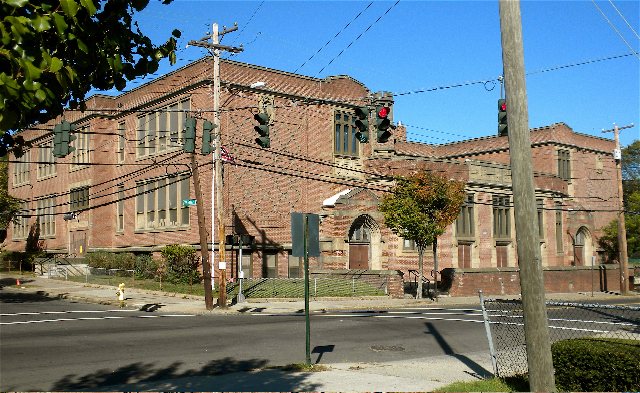
The Tudor replacement at Grand and Clinton
Strong School, New Haven
Street view of Strong School’s surviving Tudor replacement.
Read item & source notesCOLLECTION 028 · SGC-NHSS-028
Schools · photographs, documents & local history
The Fair Haven school lineage and its successive buildings at 69 Grand Avenue, illustrated by pre-fire postcards and the surviving Tudor building.
The 1808 date belongs to the local school lineage. The 1895 building burned in January 1914; the surviving Tudor replacement is generally dated 1915. A postcard postmarked 1915 still shows the destroyed building.
LOOK CLOSER · OPEN ANY IMAGE
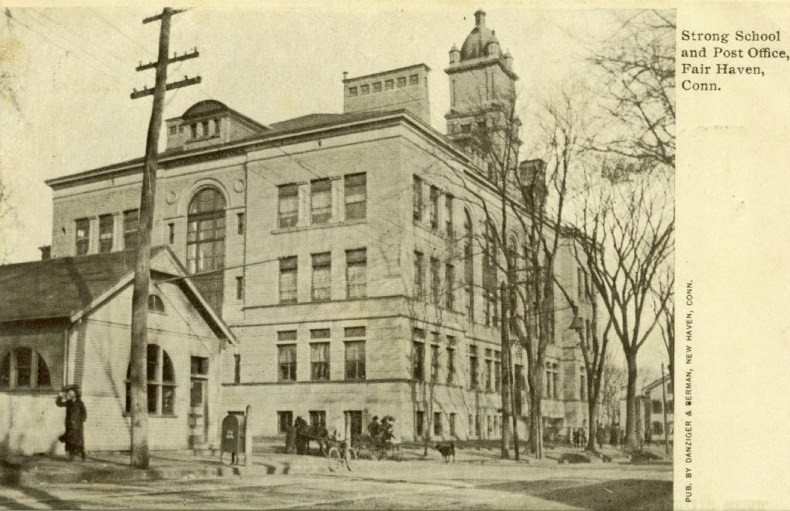
circa 1901–1907 (postcard format; photograph undated)
The postcard identifies two everyday institutions together: Strong School and the U.S. Post Office. Its view records the earlier school’s vertical tower, the tall classroom windows, utility poles and street setting. Published in the era of undivided-back postcards, it is a view of a working neighborhood, not an isolated architectural elevation. The publisher is identified as Danziger & Berman of New Haven; the exact photograph date remains unknown.
Unknown photographer; published by Danziger & Berman, New Haven; scan uploaded by Noroton / Wikimedia Commons.
Original source · Reuse termsPostmarked 1915; view predates January 1914
The 1915 postmark belongs to the card’s journey through the mail. Its picture shows the same earlier school as the pre-1907 card, including the tower and tall block-like mass, rather than the later Tudor building. Postcards could stay in circulation after the scene changed. The distinction matters here because treating the postmark as the construction date would collapse two successive school buildings into one.
Unknown postcard publisher and photographer; scan uploaded by Noroton / Wikimedia Commons.
Original source · Reuse termsOctober 2010 (EXIF: October 9)
The October 2010 photograph gives a street-level view of the later school at Grand and Clinton. Its brick frontage extends sideways across the corner, with large banks of windows and contrasting trim around the entrances. Trees, poles and passing traffic remain in the frame. They preserve the actual streetscape in which the school stood; no elements have been removed or reconstructed in the display derivative.
1914-01-27
Strong School fire with bystanders and smoke. The burning school records the event that displaced pupils before the replacement building opened in 1915.
COLLECTION HISTORY
The local school lineage begins in 1808, when Nathaniel Graniss provided land for a school. The building changed function over time: a church used it from 1830, leaving classrooms in the basement, and the school again occupied the whole structure after the church moved in 1864. This early history belongs to a predecessor, not the surviving Tudor building. [NHSS-005]
The predecessor carried the Woolsey name before a separate Woolsey School opened in 1873. It then became Grand Street School or Fair Haven School. An 1895 replacement honored Horace H. Strong, a Fair Haven warden and education-board member; fire destroyed it on January 27, 1914. [NHSS-005]
The surviving postcards make that lost building tangible. One advertises the school together with the U.S. Post Office. The other was postmarked in 1915, after the fire: a reminder that a postcard’s mailing date can preserve a view that was already out of date. Neither depicts the low, spreading replacement. [NHSS-001]
The architectural teaching unit prepared for the Yale–New Haven Teachers Institute describes the replacement at Grand and Clinton as an unusually elaborate school of the period after 1915. Its Collegiate Tudor vocabulary includes brick walls relieved by diamond-pattern decoration, extensive windows and twin towers. The school occupies the crest of Grand Avenue before the street descends toward the river. This hilltop position and broad facade gave a neighborhood public institution considerable visual presence; the author contrasted schools’ lateral reach with the upward emphasis of nearby churches. [NHSS-004]
In the February 2025 State of the City address, New Haven’s mayor named the old Strong School among sites in the housing-development pipeline. That statement is useful as a dated record of public plans. It does not establish a completion date or prove that a proposed conversion had opened. [NHSS-006]
A predecessor date and the date a school received its familiar name describe different kinds of continuity. Strong’s history should follow the institution, its premises and the community it served without assuming that a later building was present at the beginning. Photographs of pupils or a school event can broaden the architectural story, but their captions must establish the group and year. Municipal reports and school records explain decisions about organization and facilities; recollections can reveal how those decisions were experienced. Bringing them together preserves both the public institution and the daily educational life that a facade alone cannot represent. [NHSS-005] [NHSS-001] [NHSS-004]
The 1808 date belongs to the local school lineage. The 1895 building burned in January 1914; the surviving Tudor replacement is generally dated 1915. A postcard postmarked 1915 still shows the destroyed building.
THE SEARCHABLE CATALOG
Search includes catalog notes and the OCR text included with this edition. OCR may misread names or dates; use the original scan to verify a match.
NHSS-003 · Photographs · October 2010 (EXIF: October 9)
Strong School, New Haven
Street view of Strong School’s surviving Tudor replacement.
Read item & source notes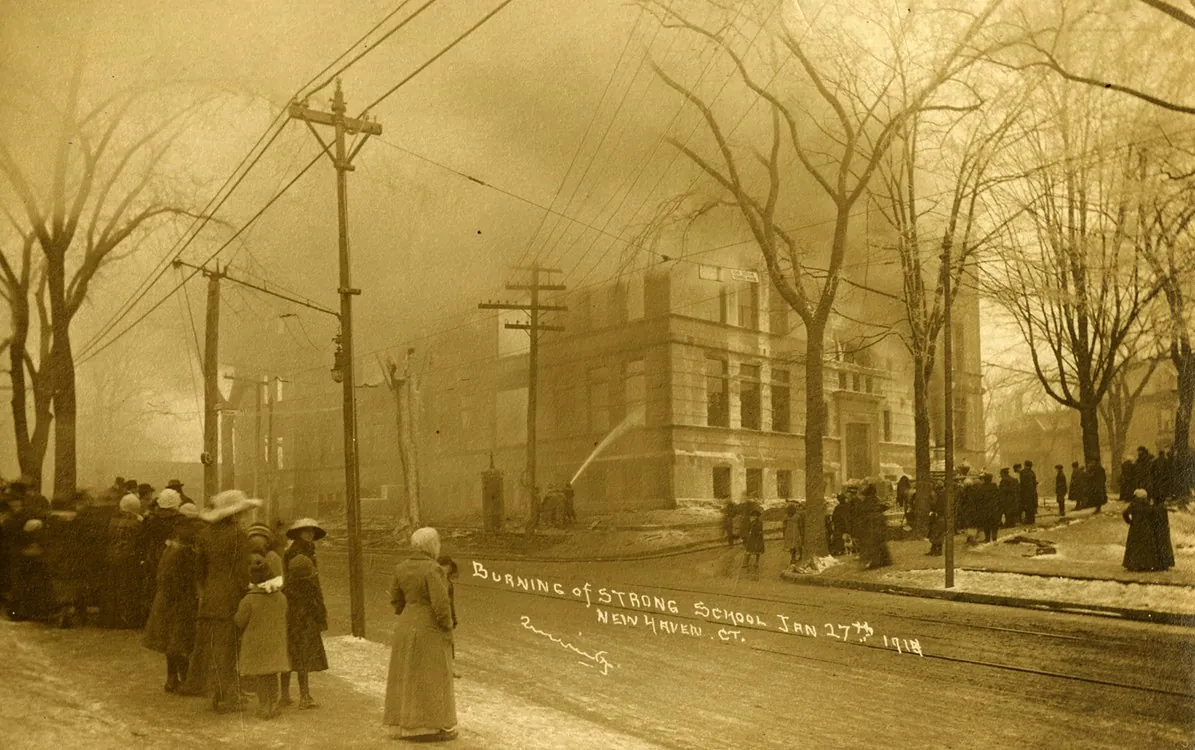
ED-L-STR-ADD-001 · Photographs · 1914-01-27
Strong School, New Haven
Strong School fire with bystanders and smoke. The burning school records the event that displaced pupils before the replacement building opened in 1915.
Read item & source notesED-L-STR-ADD-002 · Photographs · 1914; after January 27
Strong School, New Haven
The damaged Clinton Avenue elevation shows the fire’s architectural consequences.
Read item & source notesExtract the ZIP and open START_HERE.html. It includes the catalog, selected images, acquired source text, credits and a searchable SQLite database. New photo additions are hosted in the SGC media library and require an internet connection; original bundled images remain available offline.