
Windham COUNTY · Industry & working life
Phoenixville: the stone mill and its changing work
Twenty-one photographs follow a small mill from stone exterior walls to timber-framed production floors, with a history of cotton, twine and changing uses.
Historical focus · 1813–1974
LOOK CLOSER · OPEN ANY IMAGE
The story in photographs
October 1974
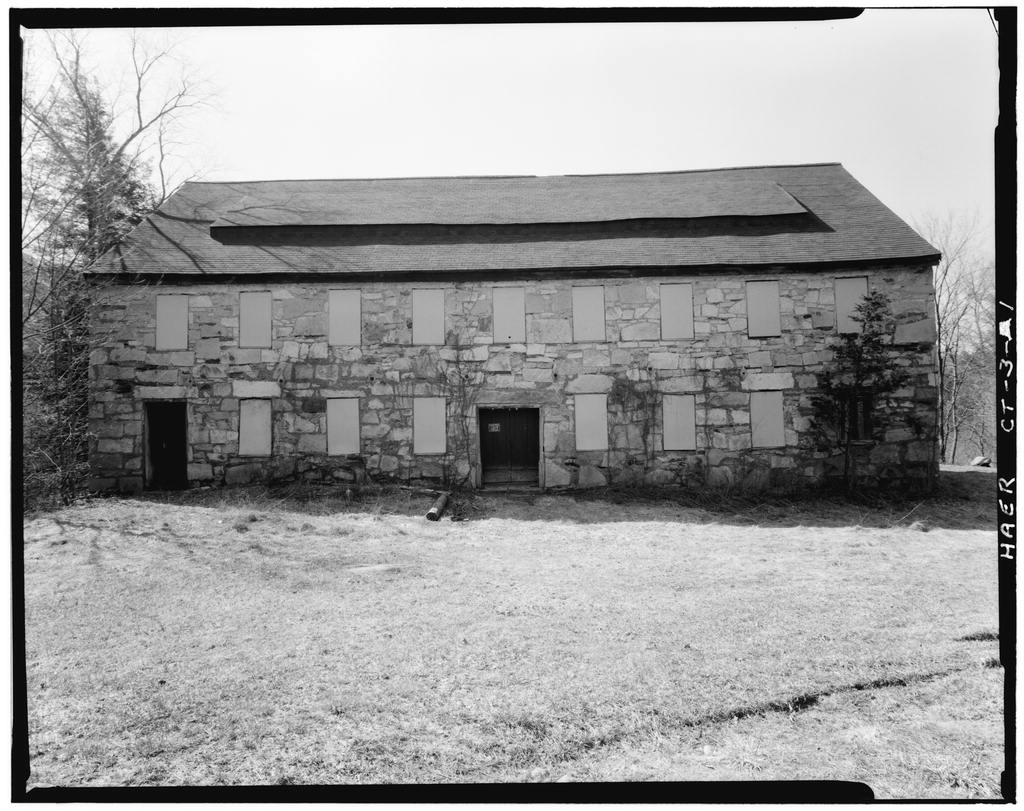
North elevation
North elevation — October 1974
Image credit & source
Donald F. Eaton / Historic American Engineering Record, Library of Congress
No known restrictions on images made by the U.S. Government; images copied from other sources may be restricted. https://www.loc.gov/rr/print/res/114_habs.html
Original source · Reuse termsOctober 1974
South elevation
South elevation — October 1974
Image credit & source
Donald F. Eaton / Historic American Engineering Record, Library of Congress
No known restrictions on images made by the U.S. Government; images copied from other sources may be restricted. https://www.loc.gov/rr/print/res/114_habs.html
Original source · Reuse termsOctober 1974
East elevation
East elevation — October 1974
Image credit & source
Donald F. Eaton / Historic American Engineering Record, Library of Congress
No known restrictions on images made by the U.S. Government; images copied from other sources may be restricted. https://www.loc.gov/rr/print/res/114_habs.html
Original source · Reuse termsOctober 1974
West elevation
West elevation — October 1974
Image credit & source
Donald F. Eaton / Historic American Engineering Record, Library of Congress
No known restrictions on images made by the U.S. Government; images copied from other sources may be restricted. https://www.loc.gov/rr/print/res/114_habs.html
Original source · Reuse termsOctober 1974
First floor: south wall, southeast corner; looking south
First floor: south wall, southeast corner; looking south — October 1974
Image credit & source
Donald F. Eaton / Historic American Engineering Record, Library of Congress
No known restrictions on images made by the U.S. Government; images copied from other sources may be restricted. https://www.loc.gov/rr/print/res/114_habs.html
Original source · Reuse termsOctober 1974
First floor: southeast corner, looking east
First floor: southeast corner, looking east — October 1974
Image credit & source
Donald F. Eaton / Historic American Engineering Record, Library of Congress
No known restrictions on images made by the U.S. Government; images copied from other sources may be restricted. https://www.loc.gov/rr/print/res/114_habs.html
Original source · Reuse termsOctober 1974
First floor: southeast corner, looking south
First floor: southeast corner, looking south — October 1974
Image credit & source
Donald F. Eaton / Historic American Engineering Record, Library of Congress
No known restrictions on images made by the U.S. Government; images copied from other sources may be restricted. https://www.loc.gov/rr/print/res/114_habs.html
Original source · Reuse termsOctober 1974
South wall, near southwest corner; looking south
South wall, near southwest corner; looking south — October 1974
Image credit & source
Donald F. Eaton / Historic American Engineering Record, Library of Congress
No known restrictions on images made by the U.S. Government; images copied from other sources may be restricted. https://www.loc.gov/rr/print/res/114_habs.html
Original source · Reuse termsOctober 1974
First floor: southwest corner, looking west
First floor: southwest corner, looking west — October 1974
Image credit & source
Donald F. Eaton / Historic American Engineering Record, Library of Congress
No known restrictions on images made by the U.S. Government; images copied from other sources may be restricted. https://www.loc.gov/rr/print/res/114_habs.html
Original source · Reuse termsOctober 1974
First floor: southwest corner, looking west
First floor: southwest corner, looking west — October 1974
Image credit & source
Donald F. Eaton / Historic American Engineering Record, Library of Congress
No known restrictions on images made by the U.S. Government; images copied from other sources may be restricted. https://www.loc.gov/rr/print/res/114_habs.html
Original source · Reuse termsOctober 1974
First floor: north wall, near northeast corner, looking north
First floor: north wall, near northeast corner, looking north — October 1974
Image credit & source
Donald F. Eaton / Historic American Engineering Record, Library of Congress
No known restrictions on images made by the U.S. Government; images copied from other sources may be restricted. https://www.loc.gov/rr/print/res/114_habs.html
Original source · Reuse termsOctober 1974
First floor: northeast corner, looking east
First floor: northeast corner, looking east — October 1974
Image credit & source
Donald F. Eaton / Historic American Engineering Record, Library of Congress
No known restrictions on images made by the U.S. Government; images copied from other sources may be restricted. https://www.loc.gov/rr/print/res/114_habs.html
Original source · Reuse termsTHE STORY BEHIND THE PHOTOGRAPHS
People, places, and change.
A factory beside the Still River
Phoenixville is a village in Eastford, in Windham County. Its stone mill belonged to an early textile landscape beside the Still River. The Sprague Manufacturing Company began with a wooden cotton factory in 1813, before the stone building was erected in 1823. The federal historical report describes a business organized by Rhode Island manufacturers and partners in what was then Ashford. Its evidence includes an 1820 return listing men, women and children in the workforce, together with spindles and looms producing brown shirting and sheeting. Industrial work here was already organized around families and specialized machinery well before the familiar late nineteenth-century factory town. [1]
Cotton machinery and financial reversals
The stone factory housed several distinct operations within a compact building. An 1830 inventory placed looms, throstles and spinning mules on its main stories, with lathes below and a dressing machine in the attic. These documentary details help explain why the interior photographs matter: floor spaces, structural framing and openings belonged to a building arranged for manufacturing. Bankruptcy brought a change of owners in 1830, when a new group adopted the Phoenix Manufacturing Company name. The following year’s record described a family labor force numbering 85 men, women and children. The report does not give every worker’s name or experience, and the later photographs cannot fill that gap. [1]
Twine, grain and uses beyond manufacturing
Further financial difficulties led to receivership in the 1840s. In 1869 the idle stone factory, houses and surrounding land passed to J. C. Randall and Edwin Harris; a map identified a twine factory there. Simeon A. Wheaton acquired the property from Harris’s heirs in 1891. The report describes a brief continuation of twine manufacture and a gristmill on the lower floor. Family recollections also describe machinery being sold during the First World War and a second floor used for dances. These later uses show how an industrial building could remain part of village life after its original production system had declined. [1]
What the 1974 photographs preserve
Donald F. Eaton photographed the mill in October 1974. His sequence begins with four exterior elevations and then moves through rooms on the first and second floors, recording walls, corners and framing from carefully identified directions. A contemporary report discussed Old Sturbridge Village’s plan to remove and re-erect the deteriorating structure as a museum exhibit. That proposal is presented here as a plan recorded in the source, without claiming its later completion. The photographs preserve the building at the date of documentation, offering unusually close views of a small mill whose history crossed several industries and generations. [1]
Keep the sources close.
Download this collection’s notes, timeline and image credits. Photographs link to their original archives and require an internet connection.
Building dates and photograph dates are recorded separately. Later photographs are identified in their captions; unknown exposure dates remain unknown. Follow each image’s credit and reuse terms.