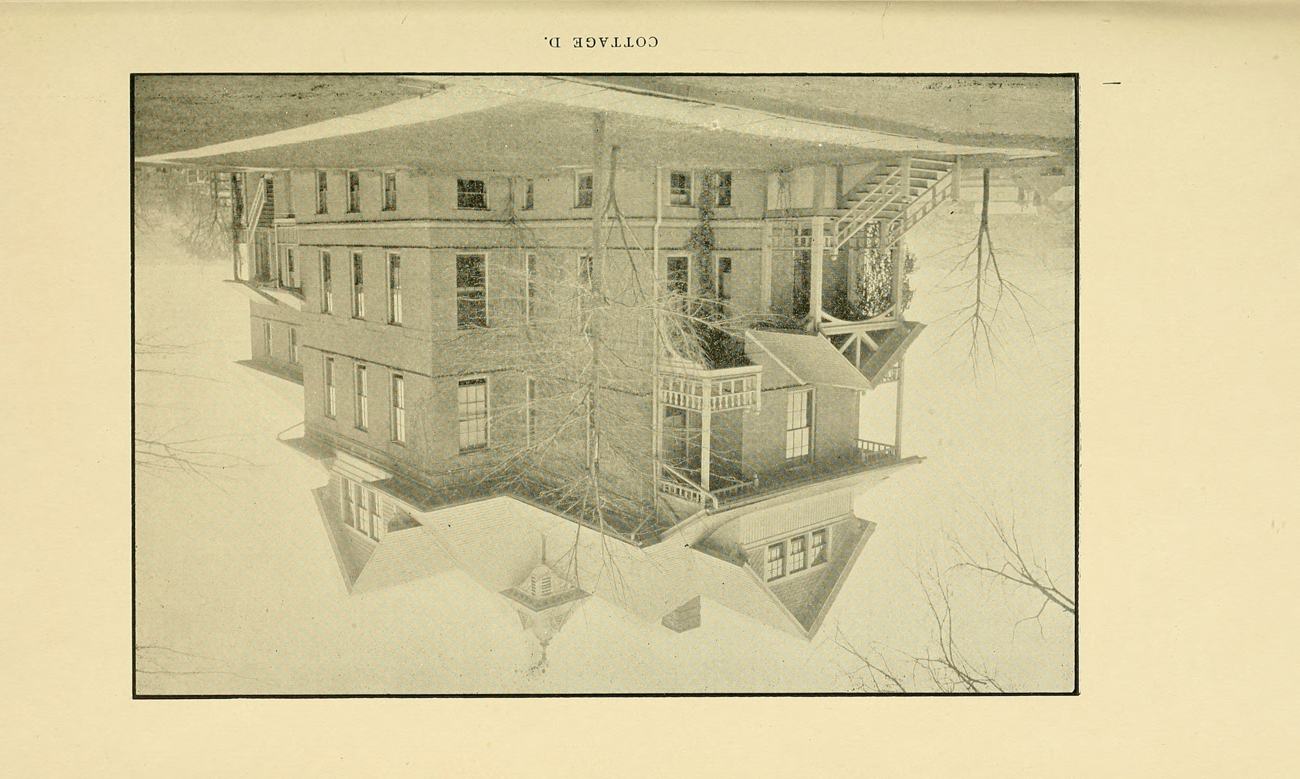
Cottage D · photograph published in the school’s 1900 report
OPENING / FIRST RECORDED DATEMarch 1, 1854
FOUNDED / HISTORICAL PERIOD1851
School for Boys. The separate Curtis Home was dedicated June 28, 1884.
LOOK CLOSER · OPEN ANY IMAGE
The story in photographs
10 images
Published 1900; exposure date unknown
Cottage A, Connecticut School for Boys
Cottage A at the Connecticut School for Boys, pictured in the school’s 1900 annual report.
Image credit & source
Connecticut School for Boys, Board of Trustees; photographer unidentified; Annual Report of the Board of Trustees of the Connecticut School for Boys, for the Year Ended September 30, 1900; State of Connecticut Public Document No. 11, bound in Public Documents, 1900, v.3, pt.3. Unnumbered plate between pp.16–17. University of Connecticut Libraries copy; Internet Archive; digitizing sponsor LYRASIS Members and Sloan Foundation
Cottage C at the Connecticut School for Boys, pictured in the school’s 1900 annual report.
Image credit & source
Connecticut School for Boys, Board of Trustees; photographer unidentified; Annual Report of the Board of Trustees of the Connecticut School for Boys, for the Year Ended September 30, 1900; State of Connecticut Public Document No. 11, bound in Public Documents, 1900, v.3, pt.3. Unnumbered plate following p.28. University of Connecticut Libraries copy; Internet Archive; digitizing sponsor LYRASIS Members and Sloan Foundation
Cottage D’s porches, windows and surrounding grounds offer a close look at the school’s built environment. Compare it with cottages A and C below. The photographs identify buildings, not the children who lived in them; the camera dates and individual occupants are not recorded.
Image credit & source
Connecticut School for Boys, Board of Trustees; photographer unidentified; Annual Report of the Board of Trustees of the Connecticut School for Boys, for the Year Ended September 30, 1900; State of Connecticut Public Document No. 11, bound in Public Documents, 1900, v.3, pt.3. Unnumbered plate between pp.32–33. University of Connecticut Libraries copy; Internet Archive; digitizing sponsor LYRASIS Members and Sloan Foundation
The caption labels this view “1854,” the year the school opened. It is an illustration reproduced in a 1912 volume. Keeping the depicted date and publication date together lets a reader see how the institution later told the story of its beginnings.
Image credit & source
Connecticut School for Boys (Meriden, Connecticut); compiled by Fred E. Tucker under Charles M. Williams; Reports of the Board of Trustees of the Connecticut School for Boys at Meriden, Conn., Volume III. Unnumbered frontispiece. University of California copy; digitized by Google; Internet Archive
Front view of the Connecticut School for Boys, an illustration published in A Century of Meriden in 1906.
Image credit & source
Charles Bancroft Gillespie and George Munson Curtis; An historic record and pictorial description of the town of Meriden, Connecticut and men who have made it (A Century of Meriden), volume II. Volume II, p.67. Library of Congress copy; Internet Archive
The 1896 physician’s report records three deaths: scarlet fever, drowning, and apparent heart trouble. It gives no names.
Image credit & source
Connecticut School for Boys (Meriden, Connecticut); compiled by Fred E. Tucker under Charles M. Williams; Reports of the Board of Trustees of the Connecticut School for Boys at Meriden, Conn., Volume III. p.355. University of California copy; digitized by Google; Internet Archive
Harold A. Meeks reports two deaths from endocarditis during the two fiscal years ending September 30, 1912.
Image credit & source
Connecticut School for Boys (Meriden, Connecticut); compiled by Fred E. Tucker under Charles M. Williams; Reports of the Board of Trustees of the Connecticut School for Boys at Meriden, Conn., Volume III. p.863 (number not printed on section-opening page). University of California copy; digitized by Google; Internet Archive
The school’s report states that it opened for pupils on March 1, 1854.
Image credit & source
Connecticut School for Boys (Meriden, Connecticut); compiled by Fred E. Tucker under Charles M. Williams; Reports of the Board of Trustees of the Connecticut School for Boys at Meriden, Conn., Volume III. p.767. University of California copy; digitized by Google; Internet Archive
This children’s building belonged to the Curtis Home. The neighboring image of accommodation for elderly women helps explain the charity’s broader purpose. Neither photograph depicts the School for Boys.
Image credit & source
Charles Bancroft Gillespie and George Munson Curtis; An historic record and pictorial description of the town of Meriden, Connecticut and men who have made it (A Century of Meriden), volume II. Volume II, p.56. Library of Congress copy; Internet Archive
The Curtis Home’s building for elderly women, labeled “Old Ladies’ Building” in the 1906 source.
Image credit & source
Charles Bancroft Gillespie and George Munson Curtis; An historic record and pictorial description of the town of Meriden, Connecticut and men who have made it (A Century of Meriden), volume II. Volume II, p.57. Library of Congress copy; Internet Archive
Read the full story of Meriden Boys’ Home & School
COLLECTION HISTORY
The people behind the place.
The Connecticut legislature established the State Reform School in 1851. A major building was completed in 1853, and the institution’s own reports date its opening to March 1, 1854. Later known as the Connecticut School for Boys, it combined a state reform-school program with education and institutional work. These different names describe the same school; they should not be confused with the privately founded Curtis Home. [MB-013]
The 1900 annual report presents a campus of lettered cottages. Its photographs show how the institution represented its buildings to the public. The physician reports preserve another part of that history: illnesses and deaths reported by the school. They are valuable primary sources, but a report’s account is the institution’s perspective, and unnamed totals cannot be turned into a list of children. [MB-012]
The cemetery remains a central research question. Read the linked 1996 investigation for the evidence used to distinguish deaths at the institution from burials on its property. The next stage is to recover and compare the underlying individual records, preserving uncertain identities and burial locations. [MB-011]
Lemuel J. Curtis’s separate home was dedicated in 1884. Its 1906 photographs show accommodation for children and elderly women. Those images broaden the history of care in Meriden, while their records and residents remain a separate body of evidence. [MB-014]
The school’s public record combines education, discipline, work and care. Cottage photographs make one arrangement of residential life visible, while physicians’ reports reveal illnesses and deaths that the architectural views cannot explain. Reading them together prevents the campus from becoming only a collection of picturesque buildings. The reports speak for the institution; a named child’s experience requires individual records and family evidence. The separate Curtis Home adds a different charitable history, accommodating children and elderly women. Its dedication in 1884 should not be used to date the state school, and its residents should not be merged with the school’s pupils. Preserving those boundaries is the first step toward recovering the people behind both institutions. [MB-013] [MB-012] [MB-011]
ESTABLISHED1851
FIRST OPENEDMarch 1, 1854
School for Boys. The separate Curtis Home was dedicated June 28, 1884.
About this research edition. This collection centers on the Connecticut School for Boys / State Reform School. “Boys’ home” can also refer to the Curtis Home; its photographs and history are explicitly labeled separately. Individual children’s death certificates and a complete named burial register have not been obtained.
PRIORITY RESEARCH
Deaths, burials & the evidence.
A physician’s total, a cemetery investigation and an individual certificate answer different questions. Start with these sources and follow their limits as carefully as their findings.
Extract the ZIP and open START_HERE.html. It includes the catalog, selected images, acquired source text, credits and a searchable SQLite database. New photo additions are hosted in the SGC media library and require an internet connection; original bundled images remain available offline.