
Hartford COUNTY · Agriculture & labor
Tobacco Valley: Fields, Sheds and Labor
The prized cigar leaf depended on intensive hand labor. Hine’s 1917 photographs preserve evidence of children’s work alongside the larger history of migration and agriculture.
Historical focus · 1875–1984
LOOK CLOSER · OPEN ANY IMAGE
The story in photographs
1917 August 3.
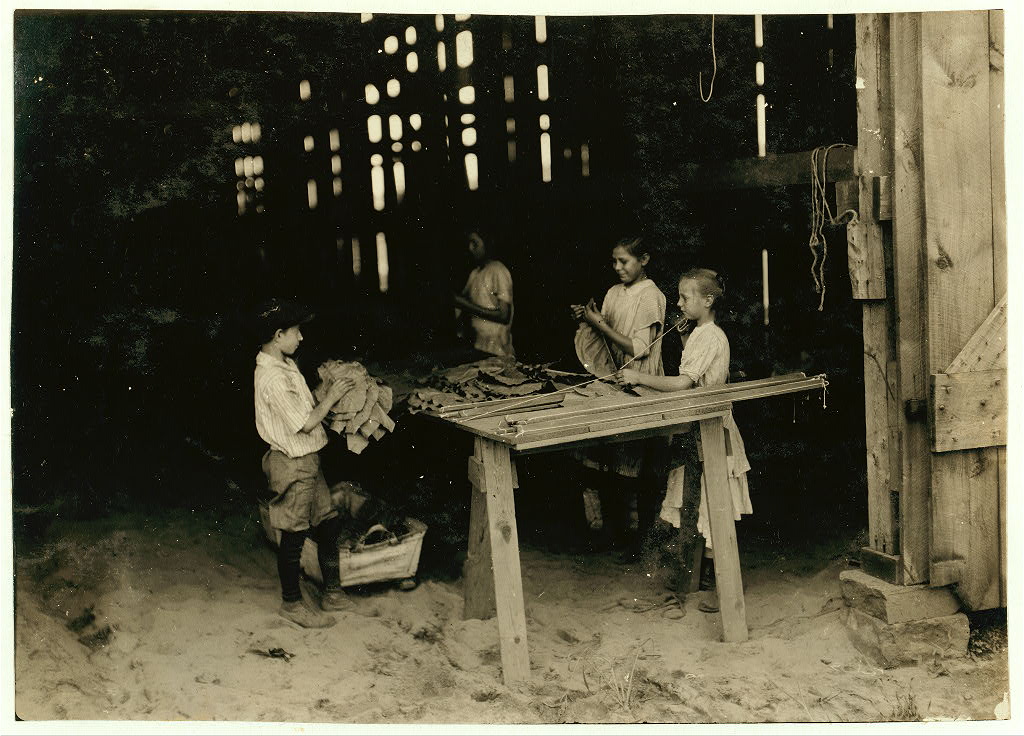
South Windsor tobacco workers, view 1
South Windsor tobacco workers, view 1 — 1917 August 3.
Image credit & source
Hine, Lewis Wickes, 1874-1940 / National Child Labor Committee collection, Library of Congress, Prints and Photographs Division
No known restrictions on publication. For information see: "National Child Labor Committee (Lewis Hine photographs)," https://hdl.loc.gov/loc.pnp/res.097.hine
Original source · Reuse terms1917 August 3.
South Windsor tobacco workers, view 2
South Windsor tobacco workers, view 2 — 1917 August 3.
Image credit & source
Hine, Lewis Wickes, 1874-1940 / National Child Labor Committee collection, Library of Congress, Prints and Photographs Division
No known restrictions on publication. For information see: "National Child Labor Committee (Lewis Hine photographs)," https://hdl.loc.gov/loc.pnp/res.097.hine
Original source · Reuse terms1917 August 3.
South Windsor tobacco workers, view 3
South Windsor tobacco workers, view 3 — 1917 August 3.
Image credit & source
Hine, Lewis Wickes, 1874-1940 / National Child Labor Committee collection, Library of Congress, Prints and Photographs Division
No known restrictions on publication. For information see: "National Child Labor Committee (Lewis Hine photographs)," https://hdl.loc.gov/loc.pnp/res.097.hine
Original source · Reuse terms1917 August 2.
South Windsor tobacco workers, view 4
South Windsor tobacco workers, view 4 — 1917 August 2.
Image credit & source
Hine, Lewis Wickes, 1874-1940 / National Child Labor Committee collection, Library of Congress, Prints and Photographs Division
No known restrictions on publication. For information see: "National Child Labor Committee (Lewis Hine photographs)," https://hdl.loc.gov/loc.pnp/res.097.hine
Original source · Reuse terms1917 August 2.
South Windsor tobacco workers, view 5
South Windsor tobacco workers, view 5 — 1917 August 2.
Image credit & source
Hine, Lewis Wickes, 1874-1940 / National Child Labor Committee collection, Library of Congress, Prints and Photographs Division
No known restrictions on publication. For information see: "National Child Labor Committee (Lewis Hine photographs)," https://hdl.loc.gov/loc.pnp/res.097.hine
Original source · Reuse terms2011 October. — later documentation
Windsor tobacco barns, documented in 2011
Windsor tobacco barns, documented in 2011 — 2011 October.
Image credit & source
Carol M. Highsmith / The George F. Landegger Collection of Connecticut Photographs / Library of Congress, Prints and Photographs Division
No known restrictions on publication.
Original source · Reuse terms1937 Sept
Tobacco near Windsor Locks, Connecticut
Tobacco near Windsor Locks, Connecticut
Image credit & source
Locke, Edwin / Library of Congress, Prints and Photographs Division
No known restrictions. For information, see U.S. Farm Security Administration/Office of War Information Black & White Photographs https://www.loc.gov/rr/print/res/071_fsab.html
Original source · Reuse terms1937 Sept
Tobacco field, Windsor Locks, Connecticut
Tobacco field, Windsor Locks, Connecticut
Image credit & source
Locke, Edwin / Library of Congress, Prints and Photographs Division
No known restrictions. For information, see U.S. Farm Security Administration/Office of War Information Black & White Photographs https://www.loc.gov/rr/print/res/071_fsab.html
Original source · Reuse terms2011 October — later documentation
Tobacco barns in Windsor, Connecticut
Tobacco barns in Windsor, Connecticut (later documentation)
Image credit & source
Highsmith, Carol M., 1946- / Library of Congress, Prints and Photographs Division
No known restrictions on publication.
Original source · Reuse termsTHE STORY BEHIND THE PHOTOGRAPHS
People, places, and change.
Growing a valuable leaf
The Connecticut Valley’s tobacco industry developed around cigar production. Broadleaf and Havana-seed varieties supplied different parts of the cigar; shade-grown tobacco became especially important for wrappers. In 1900 growers in Windsor’s Poquonock section experimented with fabric-covered fields intended to reproduce the conditions associated with imported wrapper leaf. The resulting tents and ventilated curing barns became distinctive features of the valley landscape. [1]
The children in Hine’s photographs
Lewis Hine visited American Sumatra Tobacco Company operations in South Windsor in August 1917 for the National Child Labor Committee. His captions recorded children working in fields and sheds, including boys and girls around ten to fifteen years old. The images show tasks along a production chain: leaves had to be gathered, carried, strung and prepared for curing. They document child labor in a particular place and year, not a timeless rural idyll. [2] [3]
A labor market reaching beyond the farm
Hine recorded that some children traveled from Hartford by trolley. That detail connects an agricultural workplace to the city and its transport network. In later decades the crop drew workers from the Caribbean and the American South as well as local communities. Windsor Historical Society’s records describe the Shade Tobacco Growers Agricultural Association and its recruitment and services. Those institutional records provide a different perspective from the photographs: they show how seasonal labor was organized, while personal accounts and workers’ records are needed to understand individual experience. [2] [4] [1]
Reading the landscape after the harvest
A tobacco shed’s form makes sense in relation to the crop it housed. Its openings, long interior spaces and location among fields were working features, not decorative choices. The gallery includes a 2011 photograph of Windsor tobacco barns as later documentation, clearly separated from the 1917 labor photographs. Preserving the buildings and preserving the history of the people who worked in them are complementary tasks. The record becomes more complete when a landscape of agricultural skill is also understood as a landscape of demanding labor. [5] [3]
Sources & further reading (5)
- Windsor Historical Society: Tobacco, Windsor’s Cash Crop
- Library of Congress: South Windsor field workers, August 2, 1917
- Library of Congress: South Windsor tobacco-shed workers, August 3, 1917
- Windsor Historical Society: Shade Tobacco Growers Agricultural Association records
- Library of Congress: Carol M. Highsmith, Windsor tobacco barns, 2011
Keep the sources close.
Download this collection’s notes, timeline and image credits. Photographs link to their original archives and require an internet connection.
Building dates and photograph dates are recorded separately. Later photographs are identified in their captions; unknown exposure dates remain unknown. Follow each image’s credit and reuse terms.