
Windham COUNTY · Industry & working life
Willimantic: the river that powered a thread city
Dams, turbines, stone mills and a generator trace the working systems behind Willimantic Linen and American Thread.
Historical focus · 1854–1990
LOOK CLOSER · OPEN ANY IMAGE
The story in photographs
June 1988
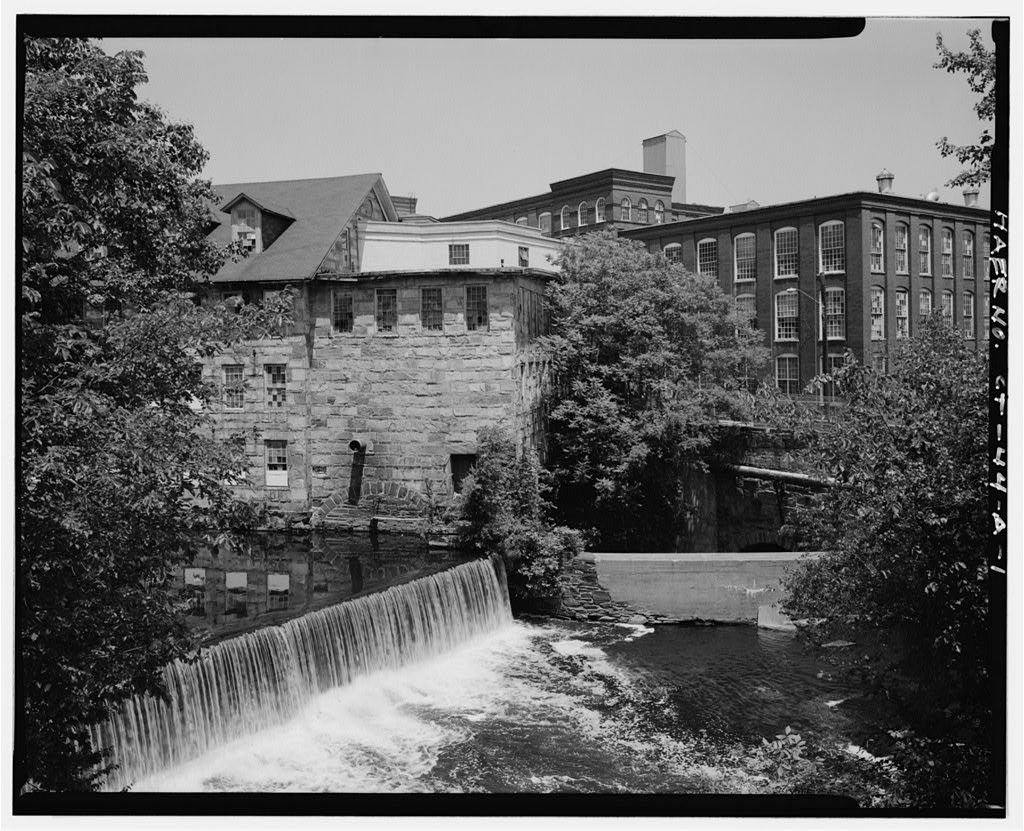
View northeast of wheelhouse area, tailrace (center), and dam; mill no. 5 (haer no. ct-44-b) and bridge at right
View northeast of wheelhouse area, tailrace (center), and dam; mill no. 5 (haer no. ct-44-b) and bridge at right — June 1988
Image credit & source
William K. Sacco / Historic American Engineering Record, Library of Congress
No known restrictions on images made by the U.S. Government; images copied from other sources may be restricted. https://www.loc.gov/rr/print/res/114_habs.html
Original source · Reuse termsJune 1988
View east of headgates at spool dam; drain gate mechanism and dam edge at right
View east of headgates at spool dam; drain gate mechanism and dam edge at right — June 1988
Image credit & source
William K. Sacco / Historic American Engineering Record, Library of Congress
No known restrictions on images made by the U.S. Government; images copied from other sources may be restricted. https://www.loc.gov/rr/print/res/114_habs.html
Original source · Reuse termsJune 1988
View west of headrace under warehouse; sluice gates at left center
View west of headrace under warehouse; sluice gates at left center — June 1988
Image credit & source
William K. Sacco / Historic American Engineering Record, Library of Congress
No known restrictions on images made by the U.S. Government; images copied from other sources may be restricted. https://www.loc.gov/rr/print/res/114_habs.html
Original source · Reuse termsJune 1988
View south of trash racks (left) and sluice gates (right)
View south of trash racks (left) and sluice gates (right) — June 1988
Image credit & source
William K. Sacco / Historic American Engineering Record, Library of Congress
No known restrictions on images made by the U.S. Government; images copied from other sources may be restricted. https://www.loc.gov/rr/print/res/114_habs.html
Original source · Reuse termsJune 1988
View west of penstock under mill
View west of penstock under mill — June 1988
Image credit & source
William K. Sacco / Historic American Engineering Record, Library of Congress
No known restrictions on images made by the U.S. Government; images copied from other sources may be restricted. https://www.loc.gov/rr/print/res/114_habs.html
Original source · Reuse termsJune 1988
View north of horizontal turbine pressure case
View north of horizontal turbine pressure case — June 1988
Image credit & source
William K. Sacco / Historic American Engineering Record, Library of Congress
No known restrictions on images made by the U.S. Government; images copied from other sources may be restricted. https://www.loc.gov/rr/print/res/114_habs.html
Original source · Reuse termsJune 1988
Detail view north of turbine output shaft, flywheel (right center), vertical shaft to governor with rack-and-pinion…
Detail view north of turbine output shaft, flywheel (right center), vertical shaft to governor with rack-and-pinion gearing (left), and belts — June 1988
Image credit & source
William K. Sacco / Historic American Engineering Record, Library of Congress
No known restrictions on images made by the U.S. Government; images copied from other sources may be restricted. https://www.loc.gov/rr/print/res/114_habs.html
Original source · Reuse termsJune 1988
View east of generator; belt-tightening mechanism at left
View east of generator; belt-tightening mechanism at left — June 1988
Image credit & source
William K. Sacco / Historic American Engineering Record, Library of Congress
No known restrictions on images made by the U.S. Government; images copied from other sources may be restricted. https://www.loc.gov/rr/print/res/114_habs.html
Original source · Reuse termsJune 1988
General view to north
General view to north — June 1988
Image credit & source
William K. Sacco / Historic American Engineering Record, Library of Congress
No known restrictions on images made by the U.S. Government; images copied from other sources may be restricted. https://www.loc.gov/rr/print/res/114_habs.html
Original source · Reuse termsJune 1988
View southwest of tailrace; dam and wheelhouse wing at center
View southwest of tailrace; dam and wheelhouse wing at center — June 1988
Image credit & source
William K. Sacco / Historic American Engineering Record, Library of Congress
No known restrictions on images made by the U.S. Government; images copied from other sources may be restricted. https://www.loc.gov/rr/print/res/114_habs.html
Original source · Reuse termsJune 1988
Detail view north of wheelhouse wing and headgates
Detail view north of wheelhouse wing and headgates — June 1988
Image credit & source
William K. Sacco / Historic American Engineering Record, Library of Congress
No known restrictions on images made by the U.S. Government; images copied from other sources may be restricted. https://www.loc.gov/rr/print/res/114_habs.html
Original source · Reuse termsJune 1988
Detail view south of south-most headgate operating mechanism (lower center); draingate operating mechanism at upper…
Detail view south of south-most headgate operating mechanism (lower center); draingate operating mechanism at upper center — June 1988
Image credit & source
William K. Sacco / Historic American Engineering Record, Library of Congress
No known restrictions on images made by the U.S. Government; images copied from other sources may be restricted. https://www.loc.gov/rr/print/res/114_habs.html
Original source · Reuse termsTHE STORY BEHIND THE PHOTOGRAPHS
People, places, and change.
From linen plans to cotton thread
The Willimantic Linen Company began operating in 1854, using cotton-mill property that had been developed in 1825 and building a much larger industrial complex beside the Willimantic River. Its early linen ambitions changed when the Crimean War disrupted European flax supplies. Thread became the central product. Mill No. 1, begun in 1854, was the first large building erected by the company. The site’s industrial importance came from the combination of production buildings, river privileges and equipment, rather than from one recognizable mill façade. The federal survey describes a complex that remained a major local source of employment for approximately 130 years. [1]
Following water through the works
Between 1854 and 1864 the company acquired or developed four successive water privileges along a steep section of the river. Mill No. 2 occupied the largest of these, with a substantial drop at its dam. The gallery follows water from gates and channels into wheelhouse spaces and out through tailraces. It also shows pressure cases, shafts, pulley wheels and a generator. These views make a manufacturing landscape legible: controlling the river and transmitting power were essential parts of producing thread, even though such spaces usually appeared less prominently than factory towers in public images of the town. [1] [3]
American Thread and changing power
American Thread purchased the Willimantic Linen Company in 1898. Around 1900–1903 it consolidated two water privileges at Mill No. 1 and installed hydroelectric equipment connected with Mill No. 5. At Mill No. 2, equipment from different generations survived together, including Swain turbine components and later S. Morgan Smith machinery. The survey carefully distinguishes physical evidence from uncertain dates: an older pressure case does not prove that all of the working equipment inside it is equally old. Steam power also served the expanding complex, reminding us that waterpower and newer technologies overlapped. [1] [2] [3]
A record made during industrial change
Thread production continued until 1984. William K. Sacco made the photographs in June 1988, before a program of hydroelectric changes at Mill No. 1 in 1988–1990. They therefore document surviving industrial equipment after thread manufacture had ended, not the mill at the height of its workforce. Their detailed captions identify viewpoints and components, helping readers connect the exterior landscape to machinery below the production floors. The original reports preserve uncertainties and describe conditions at the survey date; they should not be read as statements about what equipment remains accessible today. [1] [3]
Sources & further reading (4)
- Library of Congress: Willimantic Linen Company, Mill No. 1, Immediately West of South Main Street, North Bank of Willimantic River, Windham, Windham County, CT
- Library of Congress: Willimantic Linen Company, Mill No. 5, Immediately West of South Main Street, North Bank of Willimantic River, Windham, Windham County, CT
- Library of Congress: Willimantic Linen Company, Mill No. 2, South Main Street opposite Durham Street, North bank Willimantic River, Windham, Windham County, CT
- Connecticut State Library: CT Towns & Counties
Keep the sources close.
Download this collection’s notes, timeline and image credits. Photographs link to their original archives and require an internet connection.
Building dates and photograph dates are recorded separately. Later photographs are identified in their captions; unknown exposure dates remain unknown. Follow each image’s credit and reuse terms.