
New London COUNTY · Textile industry and mill villages
Ponemah Mills and the Workers’ Houses of Taftville
Factory interiors, monumental mill elevations, the Shetucket dam, and company housing reveal the connected industrial landscape of Taftville.
Historical focus · 1865–1970
LOOK CLOSER · OPEN ANY IMAGE
The story in photographs
June 1958
West and south elevations of original 1871 mill
West and south elevations of original 1871 mill — Ponemah Mills, Main Street, Taftville, New London County, CT
Image credit & source
Cervin Robinson; Library of Congress, Prints and Photographs Division, HABS/HAER.
No known restrictions on images made by the U.S. Government; images copied from other sources may be restricted.
Original source · Reuse termsJune 1958
West elevation showing office unit to the left later mill to the right, and original 1871 mill beyond
West elevation showing office unit to the left later mill to the right, and original 1871 mill beyond — Ponemah Mills, Main Street, Taftville, New London County, CT
Image credit & source
Cervin Robinson; Library of Congress, Prints and Photographs Division, HABS/HAER.
No known restrictions on images made by the U.S. Government; images copied from other sources may be restricted.
Original source · Reuse termsApril 1958
West elevation of original 1871 mill
West elevation of original 1871 mill — Ponemah Mills, Main Street, Taftville, New London County, CT
Image credit & source
Cervin Robinson; Library of Congress, Prints and Photographs Division, HABS/HAER.
No known restrictions on images made by the U.S. Government; images copied from other sources may be restricted.
Original source · Reuse termsMarch 1961
South and east elevations of original 1871 mill showing wing to the right
South and east elevations of original 1871 mill showing wing to the right — Ponemah Mills, Main Street, Taftville, New London County, CT
Image credit & source
Photographer not identified in the individual Library of Congress caption; Library of Congress, Prints and Photographs Division, HABS/HAER.
No known restrictions on images made by the U.S. Government; images copied from other sources may be restricted.
Original source · Reuse termsMarch 1961
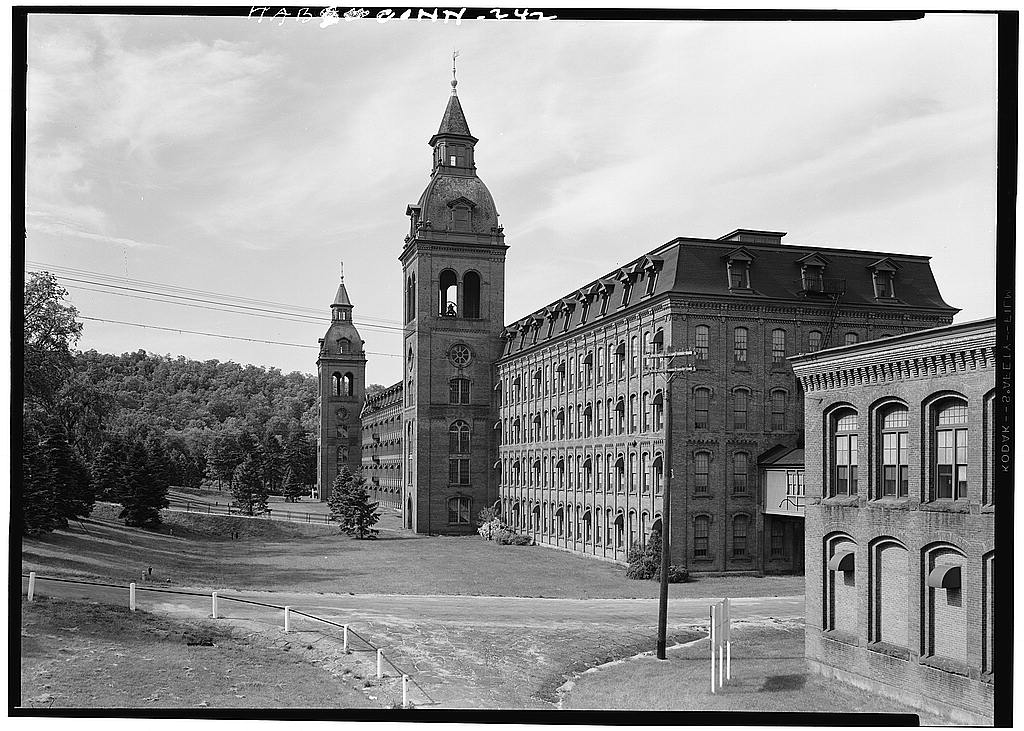
Towers on west elevation of original 1871 mill
Towers on west elevation of original 1871 mill — Ponemah Mills, Main Street, Taftville, New London County, CT
Image credit & source
Photographer not identified in the individual Library of Congress caption; Library of Congress, Prints and Photographs Division, HABS/HAER.
No known restrictions on images made by the U.S. Government; images copied from other sources may be restricted.
Original source · Reuse termsJune 1958
Interior typical of first, second, and third floors showing heavy timber mill construction
Interior typical of first, second, and third floors showing heavy timber mill construction — Ponemah Mills, Main Street, Taftville, New London County, CT
Image credit & source
Cervin Robinson; Library of Congress, Prints and Photographs Division, HABS/HAER.
No known restrictions on images made by the U.S. Government; images copied from other sources may be restricted.
Original source · Reuse termsMarch 1961
Interior of fourth floor
Interior of fourth floor — Ponemah Mills, Main Street, Taftville, New London County, CT
Image credit & source
Photographer not identified in the individual Library of Congress caption; Library of Congress, Prints and Photographs Division, HABS/HAER.
No known restrictions on images made by the U.S. Government; images copied from other sources may be restricted.
Original source · Reuse termsMarch 1961
Interior of fifth floor (attic)
Interior of fifth floor (attic) — Ponemah Mills, Main Street, Taftville, New London County, CT
Image credit & source
Photographer not identified in the individual Library of Congress caption; Library of Congress, Prints and Photographs Division, HABS/HAER.
No known restrictions on images made by the U.S. Government; images copied from other sources may be restricted.
Original source · Reuse termsMarch 1961
Ponemah mills dam on the Shetucket river
Ponemah mills dam on the Shetucket river — Ponemah Mills, Main Street, Taftville, New London County, CT
Image credit & source
Photographer not identified in the individual Library of Congress caption; Library of Congress, Prints and Photographs Division, HABS/HAER.
No known restrictions on images made by the U.S. Government; images copied from other sources may be restricted.
Original source · Reuse termsMarch 1961
East (front) and north elevations of a typical section
East (front) and north elevations of a typical section — Ponemah Mills Workers' Houses, Shetucket & Norwich Avenues, Taftville, New London County, CT
Image credit & source
Photographer not identified in the individual Library of Congress caption; Library of Congress, Prints and Photographs Division, HABS/HAER.
No known restrictions on images made by the U.S. Government; images copied from other sources may be restricted.
Original source · Reuse termsMarch 1961
East (front) and south elevations of a typical section
East (front) and south elevations of a typical section — Ponemah Mills Workers' Houses, Shetucket & Norwich Avenues, Taftville, New London County, CT
Image credit & source
Photographer not identified in the individual Library of Congress caption; Library of Congress, Prints and Photographs Division, HABS/HAER.
No known restrictions on images made by the U.S. Government; images copied from other sources may be restricted.
Original source · Reuse termsApril 1958
West (rear) elevation
West (rear) elevation — Ponemah Mills Workers' Houses, Shetucket & Norwich Avenues, Taftville, New London County, CT
Image credit & source
Cervin Robinson; Library of Congress, Prints and Photographs Division, HABS/HAER.
No known restrictions on images made by the U.S. Government; images copied from other sources may be restricted.
Original source · Reuse termsTHE STORY BEHIND THE PHOTOGRAPHS
People, places, and change.
Building a textile village
Edward Taft purchased a large tract beside the Shetucket River in 1865, seeking the waterpower needed for a major textile enterprise. Construction began the following year, and Ponemah Mills opened in 1871. Its large brick buildings and tall stair towers became landmarks of Taftville, a village within Norwich. Fine cotton fabrics were the early specialty. The investment also required a place for a substantial workforce to live, so the mill buildings and surrounding houses developed as interdependent parts of an industrial settlement. [5] [2]
Machinery, floors, and changing production
The original mill used heavy timber construction within brick walls, an arrangement clearly visible in the federal interior photographs. Additional mill buildings expanded the enterprise in the late nineteenth and early twentieth centuries. Preservation Connecticut’s industrial history records large increases in spindle capacity and changes in the amount of machinery assigned to workers. A large building alone does not explain industrial growth: production also depended on equipment, power, labor organization, and the kinds of cloth being sold. Views of upper floors, stair towers, and the river dam connect these parts of the production system. [5] [1] [2]
Work and housing beyond the mill gate
The workforce changed over time. Irish workers formed a large part of the early community; a strike in 1875 was followed by departures and increased recruitment of French Canadian workers. Company housing shaped daily life beyond the factory. The separate housing survey records several dwelling types, including long buildings divided into six apartments. In 1934, when the company began selling its housing, it owned 206 dwellings. The photographs of front and rear elevations help connect the immense mill with the repeated, more modest domestic spaces occupied by its workforce. [5] [4] [3]
A mid-century photographic record
The selected photographs carry dates in 1958 and 1961, decades after the complex’s first construction. Some explicitly credit Cervin Robinson; others identify a month and year without naming a photographer in the individual caption. The archive keeps those distinctions visible. These views preserve the original mill, later parts of the complex, work floors, dam, and workers’ houses before textile production finally ended in 1970. Together they make Taftville’s history tangible at several scales, from a single housing block to the imposing factory elevations along the river. [1] [3] [5]
Keep the sources close.
Download this collection’s notes, timeline and image credits. Photographs link to their original archives and require an internet connection.
Building dates and photograph dates are recorded separately. Later photographs are identified in their captions; unknown exposure dates remain unknown. Follow each image’s credit and reuse terms.