
Windham COUNTY · Industry & working life
Putnam: mill families, homes and a modern school
Three workers’ houses and Israel Putnam School show how a textile city housed families and invested in public education.
Historical focus · c. 1847–1986
LOOK CLOSER · OPEN ANY IMAGE
The story in photographs
June 1985
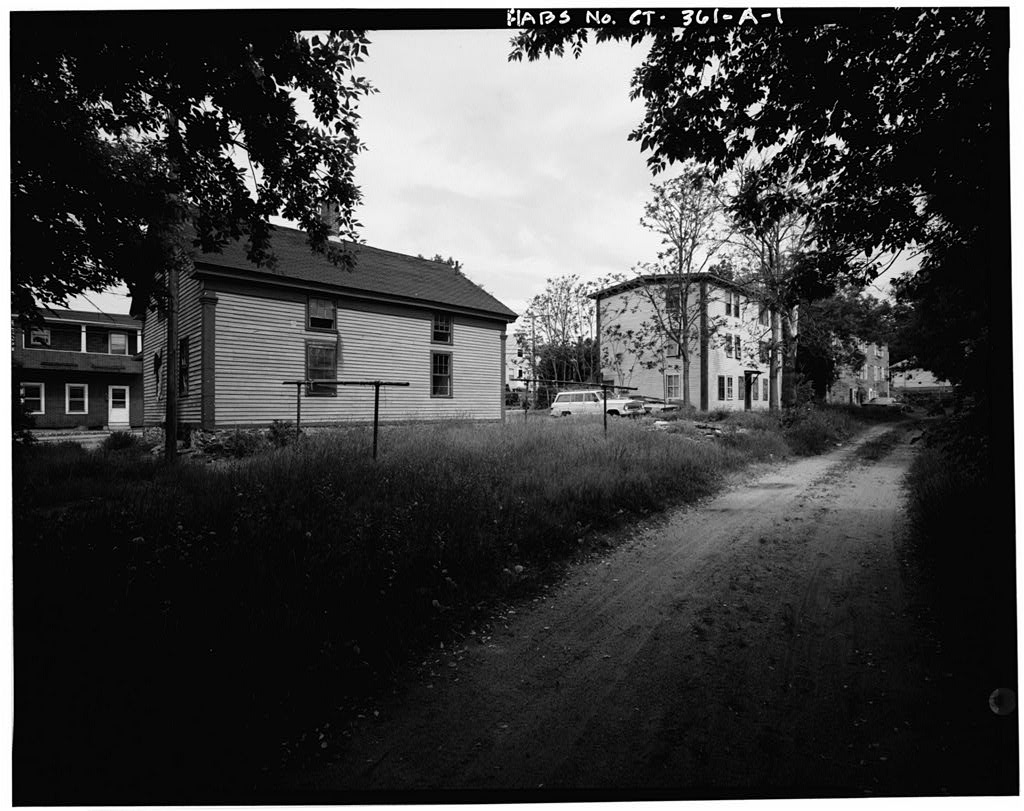
View northwest, east (rear) elevation of 305 church street with 313 and 317 church street in background
View northwest, east (rear) elevation of 305 church street with 313 and 317 church street in background — June 1985
Image credit & source
William Breadheft / Historic American Buildings Survey, Library of Congress
No known restrictions on images made by the U.S. Government; images copied from other sources may be restricted. https://www.loc.gov/rr/print/res/114_habs.html
Original source · Reuse termsJune 1985
View southwest, east (rear) and north elevations
View southwest, east (rear) and north elevations — June 1985
Image credit & source
William Breadheft / Historic American Buildings Survey, Library of Congress
No known restrictions on images made by the U.S. Government; images copied from other sources may be restricted. https://www.loc.gov/rr/print/res/114_habs.html
Original source · Reuse termsJune 1985
View north, detail of cornice and pilaster on southwest corner
View north, detail of cornice and pilaster on southwest corner — June 1985
Image credit & source
William Breadheft / Historic American Buildings Survey, Library of Congress
No known restrictions on images made by the U.S. Government; images copied from other sources may be restricted. https://www.loc.gov/rr/print/res/114_habs.html
Original source · Reuse termsJune 1985
View south, detail of typical window
View south, detail of typical window — June 1985
Image credit & source
William Breadheft / Historic American Buildings Survey, Library of Congress
No known restrictions on images made by the U.S. Government; images copied from other sources may be restricted. https://www.loc.gov/rr/print/res/114_habs.html
Original source · Reuse termsJune 1985
First floor, north front room, looking west
First floor, north front room, looking west — June 1985
Image credit & source
William Breadheft / Historic American Buildings Survey, Library of Congress
No known restrictions on images made by the U.S. Government; images copied from other sources may be restricted. https://www.loc.gov/rr/print/res/114_habs.html
Original source · Reuse termsJune 1985
Second floor, north front room, looking southeast
Second floor, north front room, looking southeast — June 1985
Image credit & source
William Breadheft / Historic American Buildings Survey, Library of Congress
No known restrictions on images made by the U.S. Government; images copied from other sources may be restricted. https://www.loc.gov/rr/print/res/114_habs.html
Original source · Reuse termsJune 1985
Second floor, south rear room, detail of partition construction
Second floor, south rear room, detail of partition construction — June 1985
Image credit & source
William Breadheft / Historic American Buildings Survey, Library of Congress
No known restrictions on images made by the U.S. Government; images copied from other sources may be restricted. https://www.loc.gov/rr/print/res/114_habs.html
Original source · Reuse termsJune 1985
View southeast, north and west (front) elevations
View southeast, north and west (front) elevations — June 1985
Image credit & source
William Breadheft / Historic American Buildings Survey, Library of Congress
No known restrictions on images made by the U.S. Government; images copied from other sources may be restricted. https://www.loc.gov/rr/print/res/114_habs.html
Original source · Reuse termsJune 1985
View northwest, east (rear) elevation
View northwest, east (rear) elevation — June 1985
Image credit & source
William Breadheft / Historic American Buildings Survey, Library of Congress
No known restrictions on images made by the U.S. Government; images copied from other sources may be restricted. https://www.loc.gov/rr/print/res/114_habs.html
Original source · Reuse termsJune 1985
View west, detail, rear entry
View west, detail, rear entry — June 1985
Image credit & source
William Breadheft / Historic American Buildings Survey, Library of Congress
No known restrictions on images made by the U.S. Government; images copied from other sources may be restricted. https://www.loc.gov/rr/print/res/114_habs.html
Original source · Reuse termsJune 1985
View east, detail, typical window
View east, detail, typical window — June 1985
Image credit & source
William Breadheft / Historic American Buildings Survey, Library of Congress
No known restrictions on images made by the U.S. Government; images copied from other sources may be restricted. https://www.loc.gov/rr/print/res/114_habs.html
Original source · Reuse termsJune 1985
First floor, north front room, looking east
First floor, north front room, looking east — June 1985
Image credit & source
William Breadheft / Historic American Buildings Survey, Library of Congress
No known restrictions on images made by the U.S. Government; images copied from other sources may be restricted. https://www.loc.gov/rr/print/res/114_habs.html
Original source · Reuse termsTHE STORY BEHIND THE PHOTOGRAPHS
People, places, and change.
A textile city beyond the factory walls
Putnam’s manufacturing history extends into its streets of housing and its school buildings. The Putnam Manufacturing Company was an integrated cotton-textile business active from 1865 to 1925, producing sheetings and later lawns and sateens. At its height it employed about 250 people. The HABS account places it among several firms that drew power from the Quinebaug River and employed many French Canadian immigrants. Their combined activity transformed the community during the nineteenth century. This collection approaches that change through places where people lived and learned, alongside the more familiar history of production. [1]
Reading three neighboring houses
The houses at 305, 313 and 317 Church Street represent two periods of construction. The smaller house at 305 was probably built around 1847 and retains modest Greek Revival details associated with that period. The other two, dating approximately to 1865, are plainer framed buildings. Repeated entrances, clapboard siding and broadly symmetrical fronts mark them as recognizable examples of New England mill housing. William Breadheft’s June 1985 photographs move from the group’s relationship along the street to windows, doorways, rooms and stairs. These details offer evidence about building form without supplying a complete account of the families who occupied each unit. [1] [2] [3] [4]
The school as a public commitment
Israel Putnam School was completed in 1902 to replace a crowded wooden predecessor. Architects J. Chandler Fowler and Edward I. Wilson gave the brick building limestone detailing and an arcaded entrance, while its plan emphasized spacious classrooms, broad corridors, light and ventilation. Enclosed steel stairways reflected concern about fire safety. A two-story wing was added in 1922 as the community’s needs grew. The original survey treats the building as both an educational facility and a visible expression of civic ambition. Its classrooms and entrances belong in the same local history as the mill tenements. [5]
Photographs before another change of use
The school ceased operating as a school around 1980. Wayne Fleming photographed it in March 1985, and the federal account records rehabilitation for senior housing in 1986. The school and housing surveys therefore preserve buildings at moments of reassessment, long after their initial construction. Looking across the two sets reveals differences in scale, ornament and access: a prominent public entrance served a different purpose from several domestic front doors. The images invite comparison while leaving residents’ individual experiences to other records such as directories, school documents and family collections. [5] [2] [3] [4]
Sources & further reading (6)
- Library of Congress: Putnam Manufacturing Company Workers' Houses, 305-317 Church Street, Putnam, Windham County, CT
- Library of Congress: Putnam Manufacturing Company Workers' Houses, 305 Church Street (House), Putnam, Windham County, CT
- Library of Congress: Putnam Manufacturing Company Workers' Houses, 313 Church Street (House), Putnam, Windham County, CT
- Library of Congress: Putnam Manufacturing Company Workers' Houses, 317 Church Street (House), Putnam, Windham County, CT
- Library of Congress: Israel Putnam School, School & Oak Streets, Putnam, Windham County, CT
- Connecticut State Library: CT Towns & Counties
Keep the sources close.
Download this collection’s notes, timeline and image credits. Photographs link to their original archives and require an internet connection.
Building dates and photograph dates are recorded separately. Later photographs are identified in their captions; unknown exposure dates remain unknown. Follow each image’s credit and reuse terms.