
Middlesex COUNTY · Industry & working life
Portland’s brownstone quarries
The stone, workers and river transport behind the nineteenth-century brownstone landscape.
Historical focus · 1850–1999
LOOK CLOSER · OPEN ANY IMAGE
The story in photographs
1911
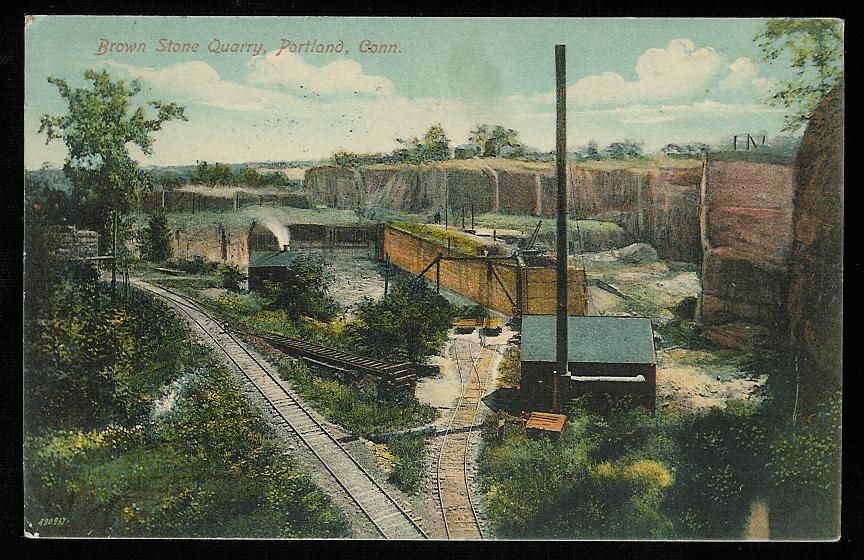
Portland brownstone quarry — historical postcard, 1911
Portland brownstone quarry — historical postcard, 1911
Image credit & source
Historical postcard / Wikimedia Commons; original creator not identified
Public domain
Original source · Reuse terms
THE STORY BEHIND THE PHOTOGRAPHS
People, places, and change.
A nineteenth-century building material
During the second half of the nineteenth century, Portland’s quarries supplied the reddish sandstone associated with urban brownstone houses. The National Park Service identifies these workings as the principal source of a material used for both grand residences and middle-class homes. A local extractive industry thus helped shape streets far beyond Connecticut. [2]
Workers and vessels
At the industry’s late-nineteenth-century height, the Town of Portland records roughly 1,500 quarry workers and at least 25 vessels carrying stone to market. The river mattered as much as the rock: it connected cutting and loading operations with buyers. The 1911 postcard in this collection supplies a period view of the quarry landscape. [1]
Stone in Portland and scientific study
The quarries also supplied local schools, churches and public buildings, including Portland’s 1894 town hall. Their significance extends beyond architecture. Geologist Paul Dimitri Krynine used evidence from Portland in a major study showing that red sedimentary beds could form in humid tropical environments, as well as arid ones. [1] [2]
Sources & further reading (2)
Keep the sources close.
Download this collection’s notes, timeline and image credits. Photographs link to their original archives and require an internet connection.
Building dates and photograph dates are recorded separately. Later photographs are identified in their captions; unknown exposure dates remain unknown. Follow each image’s credit and reuse terms.