
New London COUNTY · Railroads and movable bridges
Mystic’s Railroad Swing Bridge: A River Crossing at Work
Photographs from 1978 document the railroad swing bridge, its operator’s house, machinery, and relationship to the Mystic River.
Historical focus · 1905–1983
LOOK CLOSER · OPEN ANY IMAGE
The story in photographs
1978
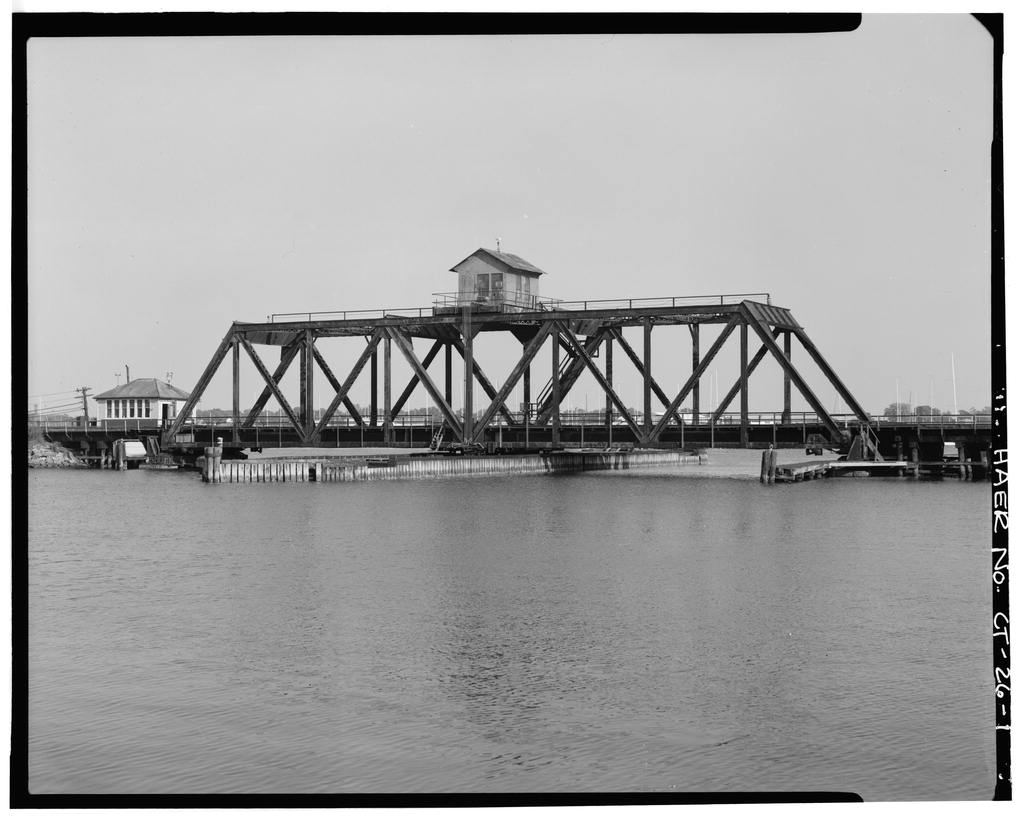
View, looking east, showing bridge closed
View, looking east, showing bridge closed — New York, New Haven & Hartford Railroad, Mystic River Bridge, Spanning Mystic River between Groton & Stonington, Groton, New London County, CT
Image credit & source
William Edmund Barrett; Library of Congress, Prints and Photographs Division, HABS/HAER.
No known restrictions on images made by the U.S. Government; images copied from other sources may be restricted.
Original source · Reuse terms1978
View, looking east, showing bridge open
View, looking east, showing bridge open — New York, New Haven & Hartford Railroad, Mystic River Bridge, Spanning Mystic River between Groton & Stonington, Groton, New London County, CT
Image credit & source
William Edmund Barrett; Library of Congress, Prints and Photographs Division, HABS/HAER.
No known restrictions on images made by the U.S. Government; images copied from other sources may be restricted.
Original source · Reuse terms1978
Detail of rack and track mechanism
Detail of rack and track mechanism — New York, New Haven & Hartford Railroad, Mystic River Bridge, Spanning Mystic River between Groton & Stonington, Groton, New London County, CT
Image credit & source
William Edmund Barrett; Library of Congress, Prints and Photographs Division, HABS/HAER.
No known restrictions on images made by the U.S. Government; images copied from other sources may be restricted.
Original source · Reuse terms1978
Detail of center pivot
Detail of center pivot — New York, New Haven & Hartford Railroad, Mystic River Bridge, Spanning Mystic River between Groton & Stonington, Groton, New London County, CT
Image credit & source
William Edmund Barrett; Library of Congress, Prints and Photographs Division, HABS/HAER.
No known restrictions on images made by the U.S. Government; images copied from other sources may be restricted.
Original source · Reuse terms1978
Detail of center pier wedges and wedge locks
Detail of center pier wedges and wedge locks — New York, New Haven & Hartford Railroad, Mystic River Bridge, Spanning Mystic River between Groton & Stonington, Groton, New London County, CT
Image credit & source
William Edmund Barrett; Library of Congress, Prints and Photographs Division, HABS/HAER.
No known restrictions on images made by the U.S. Government; images copied from other sources may be restricted.
Original source · Reuse terms1978
Detail of end pier wedge and wedge lock
Detail of end pier wedge and wedge lock — New York, New Haven & Hartford Railroad, Mystic River Bridge, Spanning Mystic River between Groton & Stonington, Groton, New London County, CT
Image credit & source
William Edmund Barrett; Library of Congress, Prints and Photographs Division, HABS/HAER.
No known restrictions on images made by the U.S. Government; images copied from other sources may be restricted.
Original source · Reuse terms1978
View, looking southeast, showing mitre rails with rail alignment guides on movable span
View, looking southeast, showing mitre rails with rail alignment guides on movable span — New York, New Haven & Hartford Railroad, Mystic River Bridge, Spanning Mystic River between Groton & Stonington, Groton, New London County, CT
Image credit & source
William Edmund Barrett; Library of Congress, Prints and Photographs Division, HABS/HAER.
No known restrictions on images made by the U.S. Government; images copied from other sources may be restricted.
Original source · Reuse terms1978
Detail, drive machinery motor
Detail, drive machinery motor — New York, New Haven & Hartford Railroad, Mystic River Bridge, Spanning Mystic River between Groton & Stonington, Groton, New London County, CT
Image credit & source
William Edmund Barrett; Library of Congress, Prints and Photographs Division, HABS/HAER.
No known restrictions on images made by the U.S. Government; images copied from other sources may be restricted.
Original source · Reuse terms1978
View, looking northeast, showing bridge approach and operator's house
View, looking northeast, showing bridge approach and operator's house — New York, New Haven & Hartford Railroad, Mystic River Bridge, Spanning Mystic River between Groton & Stonington, Groton, New London County, CT
Image credit & source
William Edmund Barrett; Library of Congress, Prints and Photographs Division, HABS/HAER.
No known restrictions on images made by the U.S. Government; images copied from other sources may be restricted.
Original source · Reuse terms1978
Interior of operator's house
Interior of operator's house — New York, New Haven & Hartford Railroad, Mystic River Bridge, Spanning Mystic River between Groton & Stonington, Groton, New London County, CT
Image credit & source
William Edmund Barrett; Library of Congress, Prints and Photographs Division, HABS/HAER.
No known restrictions on images made by the U.S. Government; images copied from other sources may be restricted.
Original source · Reuse terms1978
Interior, operator's house, electro-mechanical interlocking machine
Interior, operator's house, electro-mechanical interlocking machine — New York, New Haven & Hartford Railroad, Mystic River Bridge, Spanning Mystic River between Groton & Stonington, Groton, New London County, CT
Image credit & source
William Edmund Barrett; Library of Congress, Prints and Photographs Division, HABS/HAER.
No known restrictions on images made by the U.S. Government; images copied from other sources may be restricted.
Original source · Reuse terms1978
Interior, operator's house, foot-operated limited override switches
Interior, operator's house, foot-operated limited override switches — New York, New Haven & Hartford Railroad, Mystic River Bridge, Spanning Mystic River between Groton & Stonington, Groton, New London County, CT
Image credit & source
William Edmund Barrett; Library of Congress, Prints and Photographs Division, HABS/HAER.
No known restrictions on images made by the U.S. Government; images copied from other sources may be restricted.
Original source · Reuse termsTHE STORY BEHIND THE PHOTOGRAPHS
People, places, and change.
Where a railroad met a navigable river
The Mystic River crossing joined a coastal railroad route while preserving a passage for water traffic. The bridge in this collection carried railroad tracks between the Groton and Stonington sides of Mystic. It should be distinguished from the better-known highway drawbridge farther upstream. The federal engineering report places the railroad structure within the New Haven system’s early-twentieth-century bridge improvements. Its moving span had to serve two transportation systems whose needs intersected at the same narrow crossing: trains required a continuous track, while river vessels needed an opening through it. [2]
A new span using older infrastructure
The photographed bridge dates to 1919, with design work undertaken in 1917 by the American Bridge Company’s Edgemoor plant. It replaced a 1905 bridge while retaining elements of the earlier crossing. The center-bearing swing span rotated around its pier, opening channels on either side. The survey describes a through-truss structure and records its approaches, bearings, machinery, and protective fenders. This combination of new metalwork and retained foundations illustrates how railroad improvements often rebuilt a crossing in stages. A bridge’s visible span and the infrastructure below it need not share a single construction date. [2]
Operators, repairs, and written records
The crossing required continuing attention after construction. The engineering history records repairs in 1945 and further work on piers, machinery, and fenders during the 1950s. Its operator’s house and interlocking equipment formed part of the everyday arrangement that connected bridge movement with railroad operation. Mystic Seaport’s archival holdings include operating logs from the 1910s and 1920s, providing another kind of evidence for the crossing’s working life. Such records complement photographs: a camera preserves physical form at a particular moment, while a log can record repeated activity across days and years. [2] [4]
Views from 1978
William Edmund Barrett photographed the bridge in 1978. The sequence includes the span in different positions, structural details, machinery, the pier, and the operator’s house. Close views of the interlocking equipment connect the large riverside structure to the smaller controls associated with its operation. The historical report was prepared in 1983 for the Northeast Corridor improvement program, which contemplated changes to the crossing. This collection preserves the bridge as Barrett encountered it; it does not use these images as evidence of the later replacement’s appearance or construction date. [3] [2]
Sources & further reading (4)
- New York, New Haven & Hartford Railroad, Mystic River Bridge — Library of Congress survey record
- New York, New Haven & Hartford Railroad, Mystic River Bridge — historical and descriptive report
- New York, New Haven & Hartford Railroad, Mystic River Bridge — photograph index and photographer credits
- Mystic Seaport Museum: Mystic River railroad bridge records, Collection 214
Keep the sources close.
Download this collection’s notes, timeline and image credits. Photographs link to their original archives and require an internet connection.
Building dates and photograph dates are recorded separately. Later photographs are identified in their captions; unknown exposure dates remain unknown. Follow each image’s credit and reuse terms.