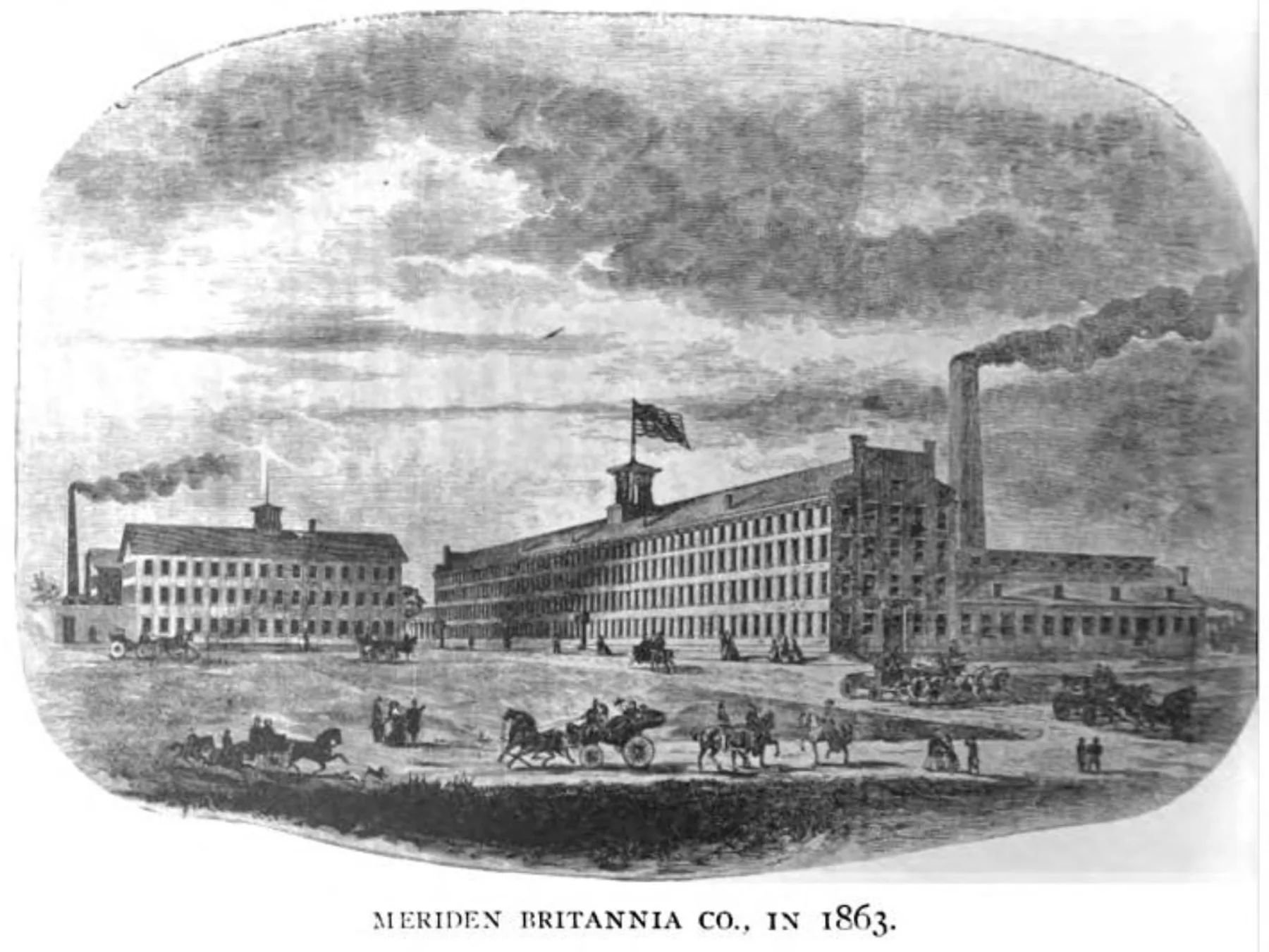
An engraved factory view labeled Meriden Britannia Co. in 1863; horses and carts fill the foreground.
Evidence, credit & reuse: Public Domain Mark 1.0. 1863, as labeled in the 1906 publication. Selected crop; complete page is available at the original source. Historical book scan; minor source clipping, uneven margins and halftone texture retained. Full page preserved separately. Selected image visually inspected; objects and principal reading text upright. No generated, colorized, or reconstructed content.
Source: Charles Bancroft Gillespie and George Munson Curtis; Journal Publishing Co., Meriden; A Century of Meriden: The Silver City, part III; New York Public Library; digitized by Google; Internet Archive
Searchable text & research notes
Included OCR or searchable notes appear below and in the download. Use your browser’s Find command to search this page. OCR errors and historical language are retained.
Read the included text
38 A CENTURY OF MERIDEX. til al>oiit the time the Meriden Bri- tannia Co. was formed that pots, plates and cups were made by rolling the metal and then pressing it into shape by means of dies or forms. The articles formed by casting were susceptible of a high polish and pre- sented quite an attractive appearance if properly cared for by the purchas- oftentimes, when poorly combined, at a low temperature, the effect of a han- dle or spout dropping oflf when in use at the table may be more easily imag- ined than described. A better com- position was afterwards employed, made of tin, antimony and copper, which was much harder and retained a more pronounced luster. Tlie out- MI:KII>F-\ HRITANNIA CO.. IN 1863. er. Tabic and tea spoons were cast and then scraped and burnished bv hand if for table use, or sold rough for cooking pury^oses. The metal first used appears to have been a com- l)ouiid of tin and lead, or practically pewter, and would easily dent, and as the solder used was composed of lead and bismuth, which would melt put of such a factory as that of Mr. Griswold could not have been large. In 1830 he employed not nuire than ten or twelve men, and in examining his sales book at that time it is found that the total sales of one month did not e.Kceed $2,500. The power used was furnished by an old blind horse traveling around a beam which com-
Cite this item
Silent Grounds Collective, Meriden Britannia Company, SGC-MBR-007, MBR-002, “Meriden Britannia factory, view labeled 1863.” Source: Charles Bancroft Gillespie and George Munson Curtis; Journal Publishing Co., Meriden; A Century of Meriden: The Silver City, part III; New York Public Library; digitized by Google; Internet Archive. https://archive.org/details/bub_gb_-zQWAAAAYAAJ/page/n1096/mode/1up. Research edition, accessed 2026-09-08.