SILENT GROUNDS COLLECTIVE · A NONPROFIT EDUCATIONAL ARCHIVEVisit SGC
SGC Digital ArchivesA Connecticut Non Profit Archive

New Haven COUNTY · Faith & community

Holy Land USA: Waterbury’s Hilltop Landmark

Explore John Greco’s miniature biblical landscape on Pine Hill, its closure and restoration, through an early-1960s photographic postcard and clearly dated later photographs.

Historical focus · 1956–1986, with later views through 2022

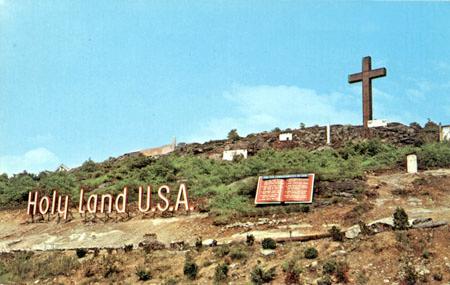
A color photographic postcard shows the Holy Land USA hillside sign, cross and miniature buildings.
Holy Land USA photographic postcard — early 1960s · Early 1960s

FOLLOW THE ORIGINAL PHOTOGRAPHS

More photographs & original records

1 selected source

Continue exploring photographs and documents in the archives that hold them. These links open external collections, with their own image credits and reuse terms.

01 · PHOTO ARCHIVE

Holy Land in 1985 and 1989 — SPACES photo archive ↗

1985 and 1989

Explore 10 photographs by Seymour Rosen from 1985 and 13 by Robert Foster from 1989 in the preservation archive’s viewer. These early post-closure views add context to the later gallery here.

Seymour Rosen / SPACES; Robert Foster / SPACES

THE STORY BEHIND THE PHOTOGRAPHS

People, places, and change.

A biblical landscape above Waterbury

Local attorney John Baptist Greco developed Holy Land USA on Pine Hill, turning a Waterbury hillside into a place for Christian storytelling and reflection. CTHumanities dates the project’s beginning to 1956; the organization’s own website dates its public opening to 1958. Those dates describe different stages of its development. The early-1960s photographic postcard in this collection records the attraction during its original era. [1] [2] [3]

A miniature world built by hand

Greco’s biblical landscape included miniature interpretations of Bethlehem and Jerusalem. The SPACES preservation archive documents an environment assembled from concrete, lumber, scrap metal, plastic, wire, purchased statues and discarded mannequins. These varied materials were part of its character. The dated 2012 photographs reveal small buildings, arches and religious imagery after years of exposure; they are records of surviving features, not photographs of the attraction at its mid-century peak. [4]

Closure and the effort to preserve it

Holy Land closed in 1984 as Greco’s health declined. After his death in 1986, the property passed to the Religious Teachers Filippini, and weather and vandalism continued to damage the site. Preservation efforts have a documentary history of their own: SPACES lists correspondence, petitions and other material from the late 1980s. Its linked photo archive preserves views made by Seymour Rosen in 1985 and Robert Foster in 1989. [3] [4]

New crosses and a return to public life

The landmark’s cross changed over time. The official history records a steel replacement in 2008 and a color-changing LED cross in 2013. Neil O’Leary and Fred Blasius purchased the property in 2013, and Holy Land reopened in September 2014 while restoration continued. The 2011 and 2022 photographs belong to this later history. They document particular moments and should not be read as a current condition report. [1] [3]

Sources & further reading (5)
  1. Holy Land USA — official history
  2. Holy Land USA — official site and opening date
  3. CTHumanities: Waterbury’s Holy Land
  4. SPACES Archives: Holy Land USA, John Greco
  5. SPACES Archives: rights and reproductions

Keep the sources close.

Download this collection’s notes, timeline and image credits. Photographs link to their original archives and require an internet connection.

Download collection notes

Building dates and photograph dates are recorded separately. Later photographs are identified in their captions; unknown exposure dates remain unknown. Follow each image’s credit and reuse terms.