An afternoon on Barbour Street
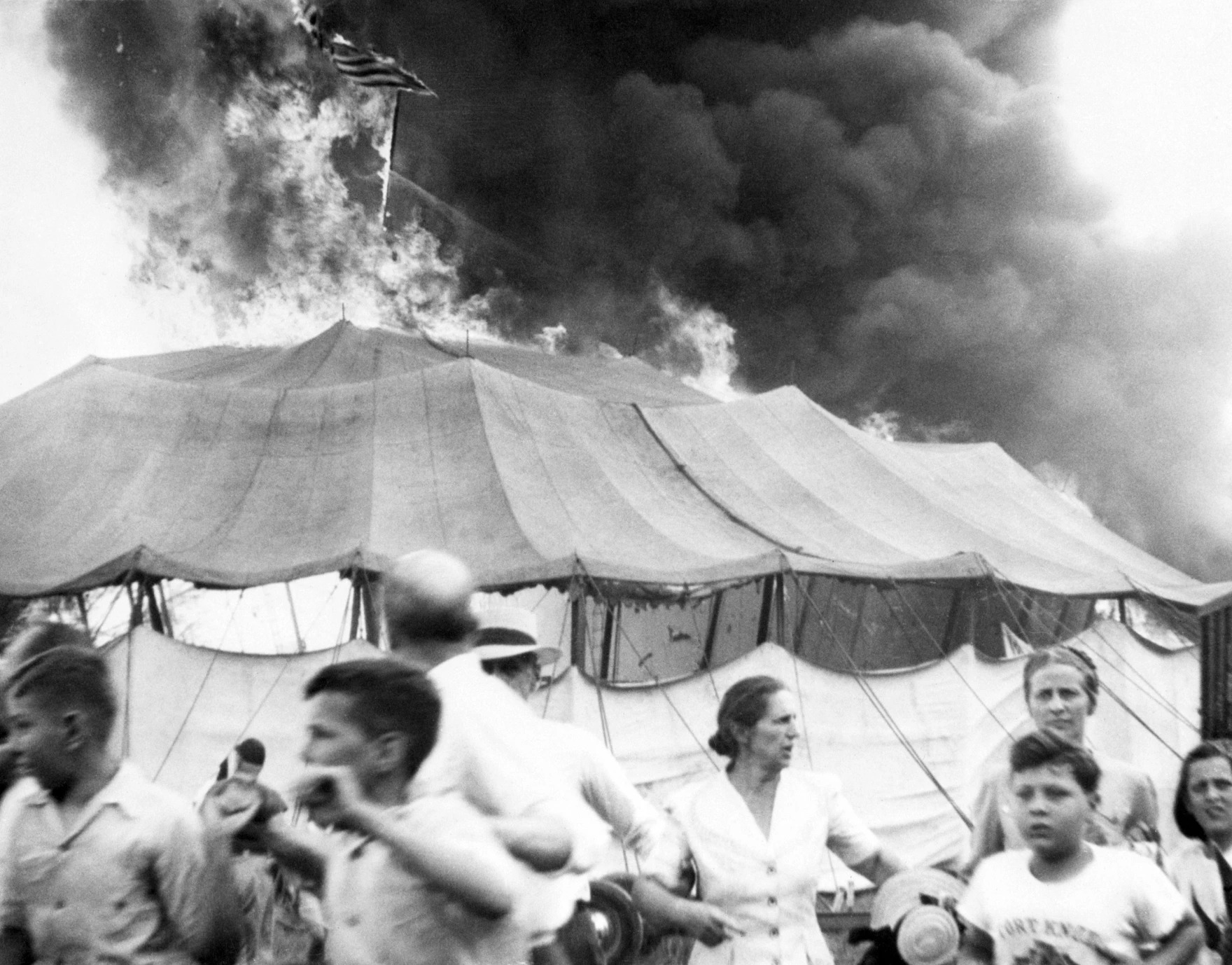
On July 6, 1944, thousands of people gathered on the Barbour Street circus grounds in Hartford for a Ringling Bros. and Barnum & Bailey matinee. Families came to see animals, clowns and aerial performers. A fire near the side of the enormous tent turned that familiar summer entertainment into catastrophe. The tent canvas had been treated with paraffin thinned with gasoline for waterproofing, a treatment that helped the flames spread with extraordinary speed. [1]
Escape, rescue and loss
As the roof burned, spectators sought exits or tried to get through the canvas sides. Animal passageways and congestion complicated escape. Circus workers and others attempted to help, but the tent collapsed within minutes. Connecticut’s Division of Criminal Justice uses a death toll of 168; other historical accounts give slightly different totals. This collection follows the state’s figure while acknowledging that casualty accounting and identification have a complicated documentary history. The photographs are presented as records of an emergency, with the victims and survivors at the center of the story. [1] [2]
What the investigations can establish
The cause should not be presented as solved. Original investigators favored an accidental ignition, while later claims of arson received extensive attention. Historian Michael Skidgell’s study reproduces the conclusions of the 1991–1993 state police re-examination: investigators could not establish the precise ignition source or eliminate all accidental causes, and the cause remained undetermined. A recanted confession is therefore not proof that a named person set the fire. Keeping this distinction visible prevents a dramatic theory from becoming an unsupported accusation. [3]
A record that extends into the cemetery
The aftermath reached far beyond the burned lot. The state archives preserve arbitration agreements and individual claimant files from 1944–1946, evidence of the effort to compensate survivors and bereaved families. Some victims could not be identified, and numbered burials at Northwood Cemetery in Windsor became part of the disaster’s enduring history. Those numbers were identification records, never a measure of a person’s worth. Researchers should consult archival finding aids for access and context, and treat disputed identifications as unresolved rather than repeating them as settled fact. [4] [2]
Neighbors became rescuers
Martha Menard’s wartime scrapbook records the Windsor Women’s Motor Corps response. The volunteers had brought convalescing soldiers from Bradley Field to the circus. Their outing became rescue work: they transported victims to hospitals and later worked at the State Armory. The scrapbook preserves local volunteer labor alongside the better-known photographs of the burning tent. [5]
A photograph and its catalog history
The Hartford History Center’s record of Emmett Kelly carrying a bucket connects a recognizable circus performer with the immediate response. Its catalog caption dates the scene to July 6, 1944 and attributes the original photograph to Ralph Emerson; the record also credits Associated Press. The record’s separate Created Date field says 1956. That metadata date should not be mistaken for the date of the fire. The source trail links the library record so that both dates and its rights statement remain visible. [8]
Rebuilding equipment and arranging compensation
Dated photographs in historian Michael Skidgell’s collection show workers and performers repairing equipment in Sarasota on July 24, 1944. These are aftermath photographs made in Florida, rather than additional views of the Hartford grounds. The circus resumed performances at Akron’s Rubber Bowl on August 4. Meanwhile, Hartford lawyers and the court arranged a receivership to preserve assets for claims. An arbitration agreement signed in November 1944 addressed compensation; the Hartford County Bar Association’s account describes the later payments and the final balance agreed in 1950. [10] [6]
Northwood: community mourning in 1944 and 1945
Six unidentified victims were buried at Northwood Cemetery on July 10, 1944. Windsor Historical Society documents neighborhood children bringing flowers and flags on the first anniversary, followed by donated headstones and a memorial stone in 1945. These records connect the disaster to sustained local care. [5]
Later remembrance and continuing identification work
The state announced a memorial groundbreaking behind Wish School for July 6, 2004; the Hartford County Bar Association records the dedication in 2005. These are later commemorations at the former circus grounds. In September 2019, a court authorized scientific testing of two unidentified victims buried at Northwood. The Division of Criminal Justice announcement describes a search for identification, not a confirmed result. The State Library’s guide also points to Edwin Thomas Hellyar Jr.’s later oral-history account of attending the circus as a child. [12] [6] [2] [7]


.jpg)