
The superintendent counted 179 employees across wards, sewing rooms, kitchens, laundry, farm and other work. The same page discusses patient work from the administration’s perspective.
Evidence, credit & reuse: Public Domain Mark 1.0, explicitly recorded in repository metadata. Not a camera photograph. Record/engraving publication date is separate from date of the events described. Passed visual review: upright; source borders and printing retained; legible at full size; no generative reconstruction.
Source: Connecticut Hospital for the Insane; Wellcome Library, via Internet Archive
Searchable text & research notes
Included OCR or searchable notes appear below and in the download. Use your browser’s Find command to search this page. OCR errors and historical language are retained.
Read the included text
CONNECTICUT HOSPITAL FOR THE INSANE.
7
And in taking care of them the resident officers are aided by
%
179 persons, employed thus:
93 in the wards and sewing-rooms.
33 in the kitchens and bakery.
18 in the laundry.
14 on the farm and gardens.
16 mechanics.
5 miscellaneous help.
That comparatively so few should suffice for the care of so
many would be surprising were it not borne in mind that a large
number of the insane habitually participate in various industrial
pursuits and thus lessen the aggregate cost of support, while
getting for themselves the benefit of occupation. In the summer
more (in the winter a little less) than half of the male patients
are employed, and at all seasons about 40 per cent, of the women.
Nevertheless the question is often asked, Why are so many
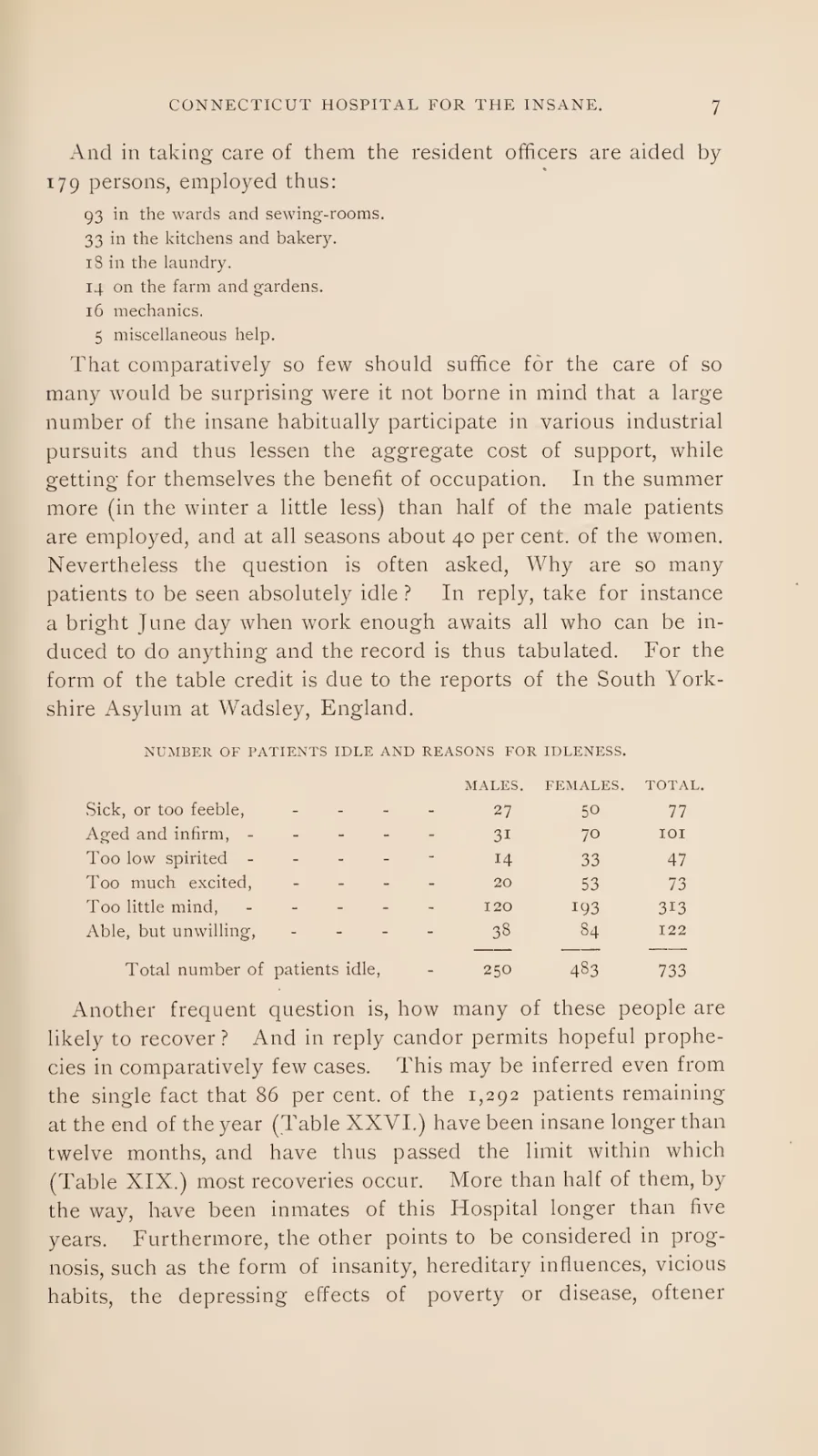
patients to be seen absolutely idle ? In reply, take for instance
a bright June day when work enough awaits all who can be in¬
duced to do anything and the record is thus tabulated. For the
form of the table credit is due to the reports of the South York¬
shire Asylum at Wadsley, England.
NUMBER OF PATIENTS IDLE AND REASONS FOR IDLENESS.
MALES. FEMALES.
TOTAL.
Sick, or too feeble,
-
27
50
77
Aged and infirm, -
_
31
70
101
Too low spirited -
-
14
33
47
Too much excited,
-
20
53
73
Too little mind,
-
120
193
3i3
Able, but unwilling,
-
38
84
122
Total number of patients idle,
250
483
733
Another frequent question is, how many of these people are
likely to recover? And in reply candor permits hopeful prophe¬
cies in comparatively few cases. This may be inferred even from
the single fact that 86 per cent, of the 1,292 patients remaining
at the end of the year (Table XXVI.) have been insane longer than
twelve months, and have thus passed the limit within which
(Table XIX.) most recoveries occur. More than half of them, by
the way, have been inmates of this Hospital longer than five
years. Furthermore, the other points to be considered in prog¬
nosis, such as the form of insanity, hereditary influences, vicious
habits, the depressing effects of poverty or disease, oftener
Cite this item
Silent Grounds Collective, Connecticut Valley Hospital, SGC-CV-017, CV-009, “Staff, work and institutional life.” Source: Connecticut Hospital for the Insane; Wellcome Library, via Internet Archive. https://archive.org/download/b30318403/b30318403.pdf#page=13. Research edition, accessed 2026-09-08.