
Hartford COUNTY · Parks & civic life
Bushnell Park and the State Capitol
Public landscape, Civil War remembrance and state government reshaped the center of Hartford over nearly a century and a half.
Historical focus · 1854–1995
LOOK CLOSER · OPEN ANY IMAGE
The story in photographs
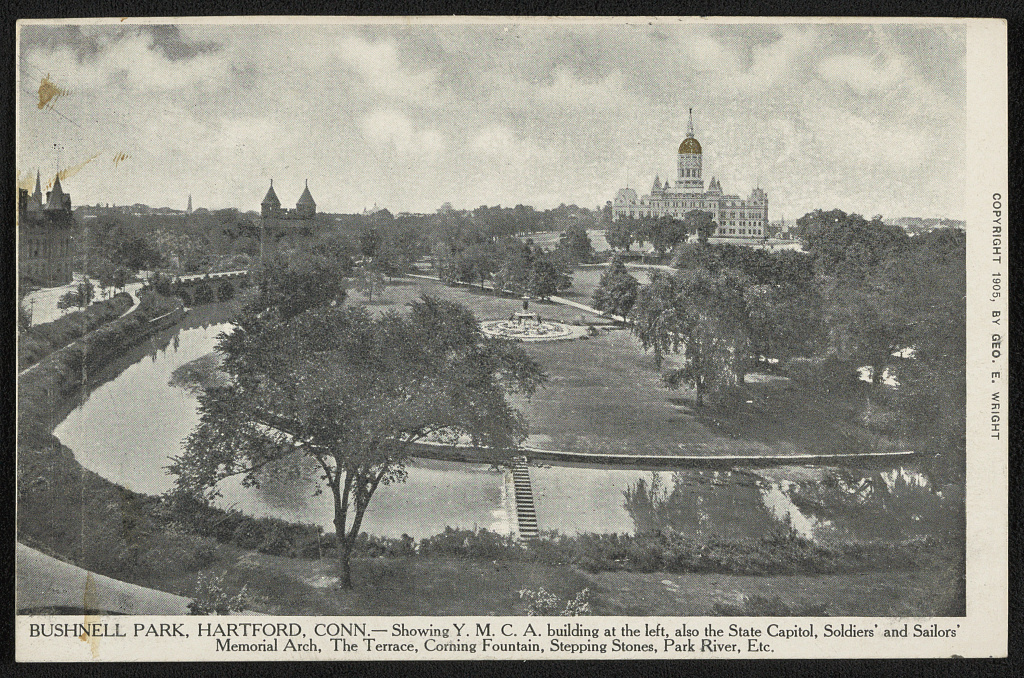
1905.
Bushnell Park panorama, 1905
Bushnell Park panorama, 1905 — 1905.
Image credit & source
Library of Congress, Prints and Photographs Division
No known restrictions on publication.
Original source · Reuse termsc1909 Nov 29.
Bushnell Park and the Capitol, 1909
Bushnell Park and the Capitol, 1909 — c1909 Nov 29.
Image credit & source
H.C. White Co. / Library of Congress, Prints and Photographs Division
Public domain in the United States; publication dated c1909 Nov 29. (copyright term expired).
Original source · Reuse termsc1906.
Memorial Arch and State Capitol, 1906
Memorial Arch and State Capitol, 1906 — c1906.
Image credit & source
Library of Congress, Prints and Photographs Division
No known restrictions on publication.
Original source · Reuse termsc[1906]
Connecticut State Capitol, 1906
Connecticut State Capitol, 1906 — c[1906]
Image credit & source
Detroit Publishing Co. / Library of Congress, Prints and Photographs Division
Public domain in the United States; publication dated c[1906] (copyright term expired).
Original source · Reuse termsc1900
Capitol, arch and fountain, Bushnell Park, Hartford, Conn
Capitol, arch and fountain, Bushnell Park, Hartford, Conn.
Image credit & source
Creator not identified in the catalog / Library of Congress, Prints and Photographs Division
No known restrictions on publication.
Original source · Reuse terms2011 September — later documentation
Bushnell Park in Hartford, Connecticut
Bushnell Park in Hartford, Connecticut (later documentation)
Image credit & source
Highsmith, Carol M., 1946- / Library of Congress, Prints and Photographs Division
No known restrictions on publication.
Original source · Reuse termsTHE STORY BEHIND THE PHOTOGRAPHS
People, places, and change.
A public investment in open space
Hartford voters approved funding for the land that became Bushnell Park in January 1854. Horace Bushnell’s proposal emerged from a growing industrial city, where crowded housing and polluted waterways made open space a civic concern. The park was not an empty rural site waiting for trees: industrial and residential uses already occupied the area. Its creation changed both the landscape and the way the city allocated space for common use. [1]
A landscape designed to be walked
Jacob Weidenmann developed the park’s 1861 plan. Frederick Law Olmsted recommended him but did not design the original park. Curving paths, varied plantings and the Park River distinguished the design from a formal town green. Period photographs are particularly useful because they preserve river edges and bridges that later disappeared. The park seen in a turn-of-the-century image is therefore a historical landscape, not simply an older photograph of today’s lawns. [1] [5]
A new seat of government
The new State Capitol opened for the General Assembly in January 1879. Richard M. Upjohn supplied the architectural plans, and contractor James G. Batterson helped shape the building that rose beside the park. Marble, granite and the gilded dome gave the government a commanding presence above the landscape. Civil War battle flags carried into the building by veterans in September 1879 made it a place of public memory as well as legislative work. [3] [4]
Memory and change
George Keller’s Soldiers and Sailors Memorial Arch was added in 1886, and Corning Fountain followed in 1899. These monuments introduced new focal points into the park. In the twentieth century the burial of the Park River removed a central element of Weidenmann’s design. Later additions, including the carousel in 1974 and performance pavilion in 1995, show that public landscapes continue to change. The archive brings these layers together so visitors can distinguish the original plan, commemorative additions and subsequent redesign. [1] [2] [5]
Keep the sources close.
Download this collection’s notes, timeline and image credits. Photographs link to their original archives and require an internet connection.
Building dates and photograph dates are recorded separately. Later photographs are identified in their captions; unknown exposure dates remain unknown. Follow each image’s credit and reuse terms.